Tag Archives: peace theology

A new book on World War II’s moral legacy

December 3, 2014—Ted Grimsrud

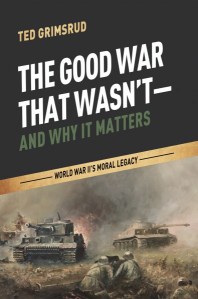
Cascade Books has just published my book, The Good War That Wasn’t—And Why It Matters: World War II’s Moral Legacy. Here is the home page for the book on my website, with links to other sites where it can be previewed and purchased.9781625641021

This book is, in essence, a pacifist’s attempt to answer the question, “what about Hitler?” or “what about World War II?” using the moral reasoning of the just war tradition and common American values.

How the book is unique, as far as I know, is that it not only interrogates the War itself, it also traces the impact of the War on American national security policy in the generations since—as well as looking closely as the story of the war opponents and their legacy. Continue reading

How empires go wrong: Paul’s message in Romans 1

Ted Grimsrud

Sermon preached at Shalom Mennonite Congregation—November 16, 2014—Romans 1:16-32

The Apostle Paul was a pretty passionate and opinionated guy. He was also a pretty deep thinker. I have come to conclude that he’s a friend of peacemakers, a friend of justice-seekers. Of course, not everyone agrees….

I argue for a peaceable Paul in these sermons on Romans. Today is the second of maybe sixteen I will do over the next couple of years. A big hurdle in understanding Paul peaceably is today’s passage—the second half of Romans, chapter one.

Before I make my case on Paul’s behalf, I want to read the verses—a bit of a condensed version. As I read, listen and think of a word or two you can share about how Paul’s thoughts here strike you.

I am not ashamed of the gospel; it is the power of God for salvation to everyone who is faithful. In it the justice of God is revealed; as it is written, “The one who is just will live by trust.” At the same time, the wrath of God is revealed from heaven against all the ungodliness and injustice of those who by their injustice suppress the truth.

What can be known about God is plain to all people, because God has shown it to them. Ever since the creation of the world God’s divine nature has been understood and seen through the things God has made. Unjust people are without excuse; for though they can know God, they do not honor or give thanks to God. They become futile in their thinking, and their minds are darkened. Though they claim to be wise, they become fools. They exchange the glory of the immortal God for images resembling a mortal human being or birds or four-footed animals or reptiles.  Continue reading

Paul’s antidote to empire

Ted Grimsrud

Sermon preached at Shalom Mennonite Congregation—October 12, 2014—Romans 1:1-17

One of the arguments I have had with several of my friends over the years concerns the writings of the Apostle Paul in the New Testament. The issue, in essence, has been whether Paul is a friend or enemy for radical, social gospel type Christians. I’d say “friend!”; they would say “enemy!” And on we’d go.

Concerns about Paul

Part of the problem for me has been that many of Paul’s biggest supporters have not been people I necessarily would want to be allied with—those who oppose welcoming gays into the church, those who support patriotic wars, those who teach a gospel of human depravity and the need for an individualistic kind of personal conversion (what I was taught years ago as the “Romans road to salvation”).

Just the other day, in one of my classes a student talked about the kind of deep pleasure he gets when he hears people speak against Paul. And that’s not surprising—Paul’s most famous piece of writing, his letter to the Romans, contains what are surely two of the most hurtful, destructive passages in all of the Bible.

I’m thinking of the part of chapter one that seems to condemn gays and lesbians. These verses are almost always cited when Bible-believers speak against Christians taking a welcoming stance. And I’m thinking of the verses in chapter 13 that begin, “let every person be subject to the governing authorities.” I know from “my scientific research” that Romans 13 is by far the most important part of the Bible for those who argue against pacifism and in favor of “necessary” war.

Yet, still, I want to say, to paraphrase Paul’s own words: “I am not ashamed of the Apostle Paul and his letter to the Romans.” And, beginning today, I want to use my “bully pulpit” here at Shalom to make a case for why this is so. I’m starting another series, this one on the book of Romans. I will show why the typical uses of Romans to support hostility toward gays and to support going to war are misuses (you’ll have to come back for those, though; I won’t get there today).

More than refuting misuses of Romans, though, I want to show how Romans can a powerful resource for peace in our broken world. I want to show how Paul gives us an “antidote to empire.” Paul presents a story that is meant to subvert, counter, even overturn the story the Roman Empire told about what matters most in life. And, sadly, we need this subversion, countering, and overturning of the story of Empire as much today as ever. Continue reading

The Peace Position During a Time of War

Ted Grimsrud

[Workshop presentation at the Eastern Mennonite Seminary School for Leadership Training, Harrisonburg, VA, January 17, 2005]

I grew up the child of a father who fought in World War II and a mother who also served in the U.S. military during that war. Our family definitely was not heavily militaristic, but I certainly would willingly have gone into the military myself had I been drafted when I was 19. As it turned out, the draft ended the year I turned 19 as the Vietnam War wound down. In the several years after that, I thought often and intensely about military service and my faith. When I was 22, through a kind of mystical awareness, I came to a clear conviction that I could not, at the same time, be both a follower of Jesus and a participant in or even supporter of warfare.

Only at this point did I first learn of the Mennonite tradition, with its long held refusal to fight in wars. I loved what I learned and, about 25 years ago, joined the Mennonite church. I continue on the process of faith seeking understanding—what does the peace position mean? What’s basis? How might it be put into practice?

Defining “pacifism,” “nonviolence,” and “nonresistance”

The most common definitions of “pacifism” focus on what pacifism rejects, characterizing pacifism as the in-principled rejection of participation in warfare. Some pacifists would say that all war is wrong, others more that they simply themselves will never fight.

Focusing on what pacifism affirms, I define pacifism as the conviction that nothing matters as much as love, kindness, respect, seeking wholeness. Hence, nothing that would justify violence matters enough to override the commitment to love. In my understanding, pacifism is a worldview, a way of looking at reality; there is a pacifist way of knowing, a pacifist way of perceiving, of discerning, of negotiating life.

The term “nonviolence” is recently prominent as a near-synonym for pacifism. I will use the terms interchangeably, though if we trying to be truly precise, we could find nuances that might make us want to differentiate between the two terms. One distinction would be to say that “pacifism” focuses more on underlying principles and values, “nonviolence” more on tactics and actions.

“Nonresistance” is the more traditional term, widely used among Mennonites, for the refusal to fight back against evil. Typically, it has carried the connotation of witnessing to peace more through living as an alternative community in some sense separate from secular politics than through direct engagement.

The Bible’s witness to peace

My definition of pacifism more in positive, worldview terms links more closely with the logic of the biblical story than simply defining pacifism as the rejection of warfare. The Bible, famously, does not overtly reject warfare for believers; in fact, in certain notorious cases the Bible actually commends, even commands, God’s people fighting. Continue reading

Question authority

Ted Grimsrud

Sermon preached at Shalom Mennonite Congregation—July 27, 2014—1 Samuel 8:10-18; Romans 13:1-4; Mark 10:42-45

I want to talk this morning about political philosophy. Now, I don’t suppose many Mennonite preachers today—or ever—have done sermons on political philosophy. But like I say to Kathleen when she asks, on occasion, what in the world are you doing, I say, I’m just trying to keep you guessing.

Actually, I think Mennonites should talk about political philosophy—and understand that we have important resources for political philosophy in our tradition. The key theme, I think, is authority. Mennonites are not nearly faithful enough to our Anabaptist heritage in relation to authority. Not that many Mennonites I know have been socialized to question authority—though doing so was essential in the beginning of our movement in the 16th century. I’d like to float a provocative thesis this morning—when we question authority we take a necessary step in developing what we could call an Anabaptist, or , to be more presumptuous, an authentically biblical, political philosophy—that is, to question authority can be an act of faithfulness.

A political awakening

But first, let me tell the story of the beginning of my political awakening. When I was a kid, I lived for sports. Sixth grade was when we first had school sports where we played other schools. After football and basketball, we’d have both baseball and track. In my eighth grade year, we thought we’d have good teams—I was excited.

Then, something terrible happened. I still remember the moment clearly. We walk into our classroom one morning and see this written on the board: “Students who wish to compete on the baseball and track teams must have crew cut haircuts. There will be no exceptions.” Now, Elkton (Oregon) Grade School in the late 1960s was not a hotbed of hippy subversion. I had only recently let my hair grow out from my standard crew cut, but it wasn’t even as long as my hair is now. Nor was anyone else’s. But there were several of us who believed this was an unreasonable demand and refused it. Continue reading

Pacifism, God, and the punishment of children

Ted Grimsrud—May 18, 2014

[This paper originated as a presentation at the conference, “Mennonites and the Family,” at Goshen College in October 1999. It has been published in Ted Grimsrud, Embodying Peace: Collected Pacifist Writings, Volume 4: Historical and Ethical Essays (Harrisonburg, VA: Peace Theology Books]

What difference does it make to assert that nothing is as important for our theology as pacifism (i.e., the cluster of values which include love, peace, shalom, wholeness, kindness, mercy, restorative justice, nonviolence, and compassion)?

I propose that one difference pacifism makes (or should make) is to cause pacifists to look critically at all justifications for violence – and to question all theological underpinnings for such justifications. In this essay, I will focus critically on one case – theological underpinnings that help justify acting violently toward children (what is commonly called corporal punishment).

I want to discuss six points concerning the theological problem of the justification of violence against children.

(1) Human beings tend to be reluctant to act violently toward other human beings. We usually require some kind of rationale to justify such violence. We must believe some value is more important than nonviolence. For Christians, this value or conviction is usually expressed in terms of “God’s will.”

(2) A theological framework, that I will call “the logic of retribution”, underlies the rationale for the use of violence against children. In “the logic of retribution,” God is understood most fundamentally in terms of impersonal, inflexible holiness. God’s law is seen to be the unchanging standard by which sin is measured. Human beings are inherently sinful. God’s response to sin is punitive. Jesus’ death on the cross is necessary as a sacrifice to provide the only basis for sinful human beings escaping their deserved punishment.

(3) Consistent pacifists must raise theological concerns here. When God is understood, as with the logic of retribution, primarily in terms of impersonal holiness, legal requirements, and strict, vengeful justice, the biblical picture of God as relational, compassionate, and responsive is distorted.

(4) Not only is it justified according to problematic theological assumptions, corporal punishment also has problematic practical consequences. It may well intensify the dynamic of responding to violence with violence, actually educating young people into the practice of using violence. It may also contribute to a stunted experience of life for its recipients.

(5) Given that all theology is humanly constructed, we may (and must) reconstruct our understanding of God in order to foster consistently pacifist theology and practice.

(6) Foundational for such a theological reconstruction, the Bible may be read as providing bases for a “logic of restoration.” According to the logic of restoration, God’s holiness is personal, flexible, dynamic, and relational. God’s justice is concerned with restoring relationships and community wholeness, not with punishment, vengeance, and balancing the impersonal scales of an eye for an eye. God’s mercy is unconditional, not dependent upon human beings in any sense earning it. Continue reading

Good grief

Ted Grimsrud

Sermon at Shalom Mennonite Congregation—April 6, 2014—John 11:35

The scripture text this morning is short, in fact don’t yawn or anything like that when I read it or you might miss it. But you probably know it. It’s the shortest verse in the Bible. The King James Version of John 11:35 says it this way: “Jesus wept.” The New Revised Standard Version is a bit more expansive: “Jesus began to weep.” I guess those translators couldn’t stand it that an entire verse had only two words.

Small verse, big message

I want to take these two (or four) words, this little Bible verse, and make a big statement. At this point of Jesus weeping, of Jesus experiencing deep grief—the word translated “wept” could actually be translated “wailed and lamented;” it signifies something quite intense—when Jesus weeps he shows us the intersection between the divine and the human like nothing else he ever did. In his grieving, Jesus most clearly shows us what God is like.

It’s notable that the Gospel of John, of all the gospels, shows us that Jesus wept. John’s Jesus is the most divine of the four gospels, the most—we could almost say—superhuman of the four Jesuses presented in the gospels. Yet John makes the point that Jesus weeps. I want to say that this fits; the most exalted, God-manifesting Jesus is the one who weeps, the one who grieves.

The godness of God is seen in God’s grief. The divine presence in humanity is seen, as much as anywhere, when we grieve. Our grief marks us as creatures made in God’s image, as creatures who possess the spark of God—even as our grief also marks us as human, all too human, fragile creatures, all too fragile.

I don’t know about you, but I don’t usually think of grief as all that great of a thing. I think of the few moments of deep grief that I have experience and I would be more than happy to have bypassed those moments. Though, as I reflect a bit, I realize that what I would want to bypass are the experiences that led to the grief, not the grief itself—grief was a response on the way to healing.

Let’s think about how we use the word grief. But first a tangent. Continue reading

Revelation Notes (Chapter 10)

Ted Grimsrud—February 19, 2014

[See notes on Revelation 9]

Revelation 9 concluded with a picture of “the rest of humankind” continuing to worship their idols even in the face of the terrible plagues that had killed “a third of humankind” (9:18). “They did not repent of their murders or their sorceries or their fornication or their thefts” (9:21). It could be that the point of this image is to underscore just how stupidly stubborn these humans are, that God—in the plagues—had tried to get them to change their ways and they continued to refuse. However, it is much more likely that a different idea is being conveyed here.

We should understand the plagues not as directly sent and controlled by God but more as a way of describing the on-going traumas of fallen human existence in history. The plagues picture something that actually (we will learn beginning in chapter 11) has its direct source in the machinations of the Dragon but that nevertheless does not defeat (and even providentially furthers) God’s purposes. Hence, we may recognize that the point here is that the plagues could not hope to bring about repentance and the turning from idols. Indeed, though this is not an explicit point the visions are making, we can understand that the plagues tend to exacerbate the problem of humanity trusting in idols.

People trust in idols, and as a consequence are pushed by the idols toward “murders, sorceries, fornication, and thefts” (9:21), because they are insecure and traumatized, fearful and in pain. So if God wants to reverse this dynamic, it would make much more sense for God to take a different tack. And this different tack, already described back in Revelation 5 (the hermeneutical key for the entire book), will be detailed beginning in chapter 10. Continue reading

Part of the Conversation? “Neo-Mennonites” and Mennonite Theology

Ted Grimsrud

[This essay was written about twenty years ago while I was pastoring a small “neo-Mennonite” congregation in Eugene, Oregon, for a festschrift honoring Gordon Kaufman. By the time the essay was published in 1996, I had left Eugene, co-pastored with my wife, Kathleen Temple, in a large, rural, pretty traditional Mennonite congregation in the midwest for two years, and gotten a job as theology professor at Eastern Mennonite University. I revised the essay in 2002 hoping to have it published again in a theological journal. That didn’t work out. I’m putting it up now mainly because I realized I hadn’t posted it on my PeaceTheology.net site yet. I also think the ideas are still relevant as Mennonites continue to struggle with the future of their tradition.][1]

The early years of the 21st-century are a time of challenge for Mennonite faith.  Mennonite churches are engaged in an intense conversation (not always self-consciously) concerning the meaning of Christianity in a tumultuous, rapidly changing world.  One of the central issues in this conversation is simply whose voices will be heard.  How will Mennonites define their faith, order their communities, prepare their young people – and who will have voices in this defining?

We face the challenges of defining major new ecclesiastical structures with the formation of Mennonite Church USA and Mennonite Church Canada.  This time of defining new structures has thus far been fraught with stress as various kinds of fault lines have been exposed and unprecedented conflicts have emerged.

This essay reflects on this issue of who partakes in Mennonite conversations about the future of their faith.  I believe our best approach is to affirm that all the voices within the current broad community of Mennonites are to be respected parts of the conversation.  To make such allowance requires an awareness of the identity of these voices.

I want to speak of one set of voices in particular, what I will call the voices of “neo-Mennonites.”  I am a bit unsure of the best shorthand term for the general perspective to which I am referring.  I will use “neo-Mennonite” as a non-value laden term[2] to refer to people who affirm at least many of the elements mentioned by Mennonite theologian Gordon Kaufman in his 1979 book Nonresistance and Responsibility:

Many persons – especially younger professional people, well-educated and living in settings quite far removed, at least culturally, from traditional rural Mennonite communities – feel the need for an interpretation of the Mennonite perspective which breathes more freely the atmosphere of the contemporary life and culture in which they are so deeply involved.  They do not wish to give up some of the basic insights and convictions of the faith in which they were raised, but the only interpretations of that faith which are readily accessible do not seem to address the questions and problems they are facing. [3]

I will argue in this essay that “neo-Mennonites” should be seen as a legitimate part of Mennonite conversations on all levels concerning the big issues that face Mennonites in the new millennium.  I will focus my concern mostly on theology, but I mean to suggest that church-wide conversations on all aspects of church life should welcome the “neo-Mennonite” perspective as a legitimate part of the Mennonite “circle.”

I do not argue that the “neo-Mennonite” perspective should be privileged, but simply that it be respected as part of the conversation.  That is, the process of discernment Mennonites are required to enter into will be most fruitful if understood as a process in which all the appropriate voices are heard and taken into account.  One of Mennonites’ biggest danger in facing our contemporary challenges is to ignore or silence voices from within our existing communities.

The “neo-Mennonite” perspective exists now within the circle of the Mennonite church.  Even if not well understood, or even acknowledged by many in the churches, it is part of what the Mennonite faith community has become.  Rather than seen as an alien perspective, or one to be resisted, it should be seen as one voice in the Mennonite choir. Continue reading

Revelation Notes (Chapter 9)

Ted Grimsrud—February 8, 2014

[See notes on Revelation 8]

In Revelation 9, the unfolding of the vision of the plagues associated with the seven trumpets continues. Chapter 8 echoed the first four of the seal visions in chapter 6, except with much more destruction. We should read these plague visions in light of their being surrounded the visions of redemption and faithfulness that we saw in the worship service of chapters 4 and 5, the multitude that stands before the Lamb in chapter 7, and—as we will see—the faithful witness of God’s people in chapters 11 and 12. Such a reading strategy will help us keep the plagues in perspective. They are not the fundamental reality. And they are not the work of a vengeful God punishing human wrongdoing.

After the four plagues of chapter 8, there is a brief interlude where a talking eagle cries out in pain in face of what the earth is facing with the plagues. The term in 8:13 that is translated “woe” could also be translated “alas!” and has the connotation of sorrow and empathy more than that this is announcing God’s direct punitive judgment.

The eagle cries out three times, pointing to the next two trumpet blasts that will be described in chapter 9 and a third “woe” that does not have a clear referent. The seventh trumpet blast (11:15-19) could be the third “woe”—in which case since the focus with the trumpet is the promise that God will “destroy the destroyers of the earth” (11:18), the idea could be that this “woe” will end all the “woes” by doing away with the actual source of the destruction, the Dragon and his minions. Beginning with chapter 9, Revelation makes it increasingly clear that the Dragon is the direct actor behind the plagues.

The fifth and sixth trumpets do speak of more trauma on earth and give more detail to the picture of this time of the “3 1/2 years” between Jesus’s victory described in Revelation 5 and the coming of the New Jerusalem in chapter 21.

Continue reading