Pacifism, God, and the punishment of children

Ted Grimsrud—May 18, 2014

[This paper originated as a presentation at the conference, “Mennonites and the Family,” at Goshen College in October 1999. It has been published in Ted Grimsrud, Embodying Peace: Collected Pacifist Writings, Volume 4: Historical and Ethical Essays (Harrisonburg, VA: Peace Theology Books]

What difference does it make to assert that nothing is as important for our theology as pacifism (i.e., the cluster of values which include love, peace, shalom, wholeness, kindness, mercy, restorative justice, nonviolence, and compassion)?

I propose that one difference pacifism makes (or should make) is to cause pacifists to look critically at all justifications for violence – and to question all theological underpinnings for such justifications. In this essay, I will focus critically on one case – theological underpinnings that help justify acting violently toward children (what is commonly called corporal punishment).

I want to discuss six points concerning the theological problem of the justification of violence against children.

(1) Human beings tend to be reluctant to act violently toward other human beings. We usually require some kind of rationale to justify such violence. We must believe some value is more important than nonviolence. For Christians, this value or conviction is usually expressed in terms of “God’s will.”

(2) A theological framework, that I will call “the logic of retribution”, underlies the rationale for the use of violence against children. In “the logic of retribution,” God is understood most fundamentally in terms of impersonal, inflexible holiness. God’s law is seen to be the unchanging standard by which sin is measured. Human beings are inherently sinful. God’s response to sin is punitive. Jesus’ death on the cross is necessary as a sacrifice to provide the only basis for sinful human beings escaping their deserved punishment.

(3) Consistent pacifists must raise theological concerns here. When God is understood, as with the logic of retribution, primarily in terms of impersonal holiness, legal requirements, and strict, vengeful justice, the biblical picture of God as relational, compassionate, and responsive is distorted.

(4) Not only is it justified according to problematic theological assumptions, corporal punishment also has problematic practical consequences. It may well intensify the dynamic of responding to violence with violence, actually educating young people into the practice of using violence. It may also contribute to a stunted experience of life for its recipients.

(5) Given that all theology is humanly constructed, we may (and must) reconstruct our understanding of God in order to foster consistently pacifist theology and practice.

(6) Foundational for such a theological reconstruction, the Bible may be read as providing bases for a “logic of restoration.” According to the logic of restoration, God’s holiness is personal, flexible, dynamic, and relational. God’s justice is concerned with restoring relationships and community wholeness, not with punishment, vengeance, and balancing the impersonal scales of an eye for an eye. God’s mercy is unconditional, not dependent upon human beings in any sense earning it. Continue reading

Good grief

Ted Grimsrud

Sermon at Shalom Mennonite Congregation—April 6, 2014—John 11:35

The scripture text this morning is short, in fact don’t yawn or anything like that when I read it or you might miss it. But you probably know it. It’s the shortest verse in the Bible. The King James Version of John 11:35 says it this way: “Jesus wept.” The New Revised Standard Version is a bit more expansive: “Jesus began to weep.” I guess those translators couldn’t stand it that an entire verse had only two words.

Small verse, big message

I want to take these two (or four) words, this little Bible verse, and make a big statement. At this point of Jesus weeping, of Jesus experiencing deep grief—the word translated “wept” could actually be translated “wailed and lamented;” it signifies something quite intense—when Jesus weeps he shows us the intersection between the divine and the human like nothing else he ever did. In his grieving, Jesus most clearly shows us what God is like.

It’s notable that the Gospel of John, of all the gospels, shows us that Jesus wept. John’s Jesus is the most divine of the four gospels, the most—we could almost say—superhuman of the four Jesuses presented in the gospels. Yet John makes the point that Jesus weeps. I want to say that this fits; the most exalted, God-manifesting Jesus is the one who weeps, the one who grieves.

The godness of God is seen in God’s grief. The divine presence in humanity is seen, as much as anywhere, when we grieve. Our grief marks us as creatures made in God’s image, as creatures who possess the spark of God—even as our grief also marks us as human, all too human, fragile creatures, all too fragile.

I don’t know about you, but I don’t usually think of grief as all that great of a thing. I think of the few moments of deep grief that I have experience and I would be more than happy to have bypassed those moments. Though, as I reflect a bit, I realize that what I would want to bypass are the experiences that led to the grief, not the grief itself—grief was a response on the way to healing.

Let’s think about how we use the word grief. But first a tangent. Continue reading

Revelation Notes (Chapter 10)

Ted Grimsrud—February 19, 2014

[See notes on Revelation 9]

Revelation 9 concluded with a picture of “the rest of humankind” continuing to worship their idols even in the face of the terrible plagues that had killed “a third of humankind” (9:18). “They did not repent of their murders or their sorceries or their fornication or their thefts” (9:21). It could be that the point of this image is to underscore just how stupidly stubborn these humans are, that God—in the plagues—had tried to get them to change their ways and they continued to refuse. However, it is much more likely that a different idea is being conveyed here.

We should understand the plagues not as directly sent and controlled by God but more as a way of describing the on-going traumas of fallen human existence in history. The plagues picture something that actually (we will learn beginning in chapter 11) has its direct source in the machinations of the Dragon but that nevertheless does not defeat (and even providentially furthers) God’s purposes. Hence, we may recognize that the point here is that the plagues could not hope to bring about repentance and the turning from idols. Indeed, though this is not an explicit point the visions are making, we can understand that the plagues tend to exacerbate the problem of humanity trusting in idols.

People trust in idols, and as a consequence are pushed by the idols toward “murders, sorceries, fornication, and thefts” (9:21), because they are insecure and traumatized, fearful and in pain. So if God wants to reverse this dynamic, it would make much more sense for God to take a different tack. And this different tack, already described back in Revelation 5 (the hermeneutical key for the entire book), will be detailed beginning in chapter 10. Continue reading

Part of the Conversation? “Neo-Mennonites” and Mennonite Theology

Ted Grimsrud

[This essay was written about twenty years ago while I was pastoring a small “neo-Mennonite” congregation in Eugene, Oregon, for a festschrift honoring Gordon Kaufman. By the time the essay was published in 1996, I had left Eugene, co-pastored with my wife, Kathleen Temple, in a large, rural, pretty traditional Mennonite congregation in the midwest for two years, and gotten a job as theology professor at Eastern Mennonite University. I revised the essay in 2002 hoping to have it published again in a theological journal. That didn’t work out. I’m putting it up now mainly because I realized I hadn’t posted it on my PeaceTheology.net site yet. I also think the ideas are still relevant as Mennonites continue to struggle with the future of their tradition.][1]

The early years of the 21st-century are a time of challenge for Mennonite faith.  Mennonite churches are engaged in an intense conversation (not always self-consciously) concerning the meaning of Christianity in a tumultuous, rapidly changing world.  One of the central issues in this conversation is simply whose voices will be heard.  How will Mennonites define their faith, order their communities, prepare their young people – and who will have voices in this defining?

We face the challenges of defining major new ecclesiastical structures with the formation of Mennonite Church USA and Mennonite Church Canada.  This time of defining new structures has thus far been fraught with stress as various kinds of fault lines have been exposed and unprecedented conflicts have emerged.

This essay reflects on this issue of who partakes in Mennonite conversations about the future of their faith.  I believe our best approach is to affirm that all the voices within the current broad community of Mennonites are to be respected parts of the conversation.  To make such allowance requires an awareness of the identity of these voices.

I want to speak of one set of voices in particular, what I will call the voices of “neo-Mennonites.”  I am a bit unsure of the best shorthand term for the general perspective to which I am referring.  I will use “neo-Mennonite” as a non-value laden term[2] to refer to people who affirm at least many of the elements mentioned by Mennonite theologian Gordon Kaufman in his 1979 book Nonresistance and Responsibility:

Many persons – especially younger professional people, well-educated and living in settings quite far removed, at least culturally, from traditional rural Mennonite communities – feel the need for an interpretation of the Mennonite perspective which breathes more freely the atmosphere of the contemporary life and culture in which they are so deeply involved.  They do not wish to give up some of the basic insights and convictions of the faith in which they were raised, but the only interpretations of that faith which are readily accessible do not seem to address the questions and problems they are facing. [3]

I will argue in this essay that “neo-Mennonites” should be seen as a legitimate part of Mennonite conversations on all levels concerning the big issues that face Mennonites in the new millennium.  I will focus my concern mostly on theology, but I mean to suggest that church-wide conversations on all aspects of church life should welcome the “neo-Mennonite” perspective as a legitimate part of the Mennonite “circle.”

I do not argue that the “neo-Mennonite” perspective should be privileged, but simply that it be respected as part of the conversation.  That is, the process of discernment Mennonites are required to enter into will be most fruitful if understood as a process in which all the appropriate voices are heard and taken into account.  One of Mennonites’ biggest danger in facing our contemporary challenges is to ignore or silence voices from within our existing communities.

The “neo-Mennonite” perspective exists now within the circle of the Mennonite church.  Even if not well understood, or even acknowledged by many in the churches, it is part of what the Mennonite faith community has become.  Rather than seen as an alien perspective, or one to be resisted, it should be seen as one voice in the Mennonite choir. Continue reading

Revelation Notes (Chapter 9)

Ted Grimsrud—February 8, 2014

[See notes on Revelation 8]

In Revelation 9, the unfolding of the vision of the plagues associated with the seven trumpets continues. Chapter 8 echoed the first four of the seal visions in chapter 6, except with much more destruction. We should read these plague visions in light of their being surrounded the visions of redemption and faithfulness that we saw in the worship service of chapters 4 and 5, the multitude that stands before the Lamb in chapter 7, and—as we will see—the faithful witness of God’s people in chapters 11 and 12. Such a reading strategy will help us keep the plagues in perspective. They are not the fundamental reality. And they are not the work of a vengeful God punishing human wrongdoing.

After the four plagues of chapter 8, there is a brief interlude where a talking eagle cries out in pain in face of what the earth is facing with the plagues. The term in 8:13 that is translated “woe” could also be translated “alas!” and has the connotation of sorrow and empathy more than that this is announcing God’s direct punitive judgment.

The eagle cries out three times, pointing to the next two trumpet blasts that will be described in chapter 9 and a third “woe” that does not have a clear referent. The seventh trumpet blast (11:15-19) could be the third “woe”—in which case since the focus with the trumpet is the promise that God will “destroy the destroyers of the earth” (11:18), the idea could be that this “woe” will end all the “woes” by doing away with the actual source of the destruction, the Dragon and his minions. Beginning with chapter 9, Revelation makes it increasingly clear that the Dragon is the direct actor behind the plagues.

The fifth and sixth trumpets do speak of more trauma on earth and give more detail to the picture of this time of the “3 1/2 years” between Jesus’s victory described in Revelation 5 and the coming of the New Jerusalem in chapter 21.

Continue reading

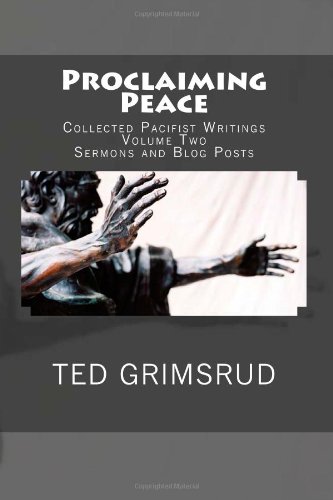
NEW BOOK: Proclaiming Peace by Ted Grimsrud

41BHQZyn1AL

A Mennonite pastor and blogger gathers fifty short writings that present a powerful message of world transformation and healing inspired by Jesus’ way of shalom.

TABLE OF CONTENTS

SECTION ONE: Sermons

A. Introduction to Pacifism

B. Old Testament

C. Gospels

D. New Testament Writings

SECTION TWO: Blog Posts

A. Pacifism

B. World War II

C. Theology

PUBLICATION DATA

Ted Grimsrud. Proclaiming Peace: Collected Pacifist Writings, Volume Two: Sermons and Blog Posts. Harrisonburg, Virginia: Peace Theology Books, 2013. ix + 226 pages. [See a preview of the book on the Amazon site.]

ENDORSING BLURB

“I read many peace-related blogs. I am here to say that if you only read on internet site related to Christian peacemaking, read Ted Grimsrud’s PeaceTheology.net. In his accompanying blog, ThinkingPacifism.net, he is ‘thinking aloud’ on peace-related subjects in perceptive ways. Ted is charting what I believe to be the most hopeful ‘post-John Howard Yoder’ path in Anabaptist pacifist thought.”—Michael Westmoreland-While, Pilgrim Pathways

PURCHASING INFORMATION

This book may be purchased from the following e-retailers:

Amazon ($13.50)

Barnes and Noble ($13.68)

Amazon Kindle ($5)

Powell’s Books ($15.50)

It may also be purchased directly from the author for $10 (only in person, no mail orders)

Reflections from a chagrined “Yoderian” in face of his alleged sexual violence

Ted Grimsrud

[A slightly different version of this essay was published in J. Denny Weaver, ed., John Howard Yoder: Radical Theologian (Cascade Books, 2014), 334-50. It is a condensed and revised version from several blog posts I wrote in August, 2013, beginning on August 2.]

The Yoder dilemma

In June 1992, in a series of investigative articles by reporter Tom Price, the Elkhart Truth, John Howard Yoder’s hometown newspaper, reported on widespread allegations about coercive sexual activities by Yoder. These allegations led to a disciplinary process from the Indiana-Michigan Mennonite Conference in relation to Yoder’s ministerial credentials. [1]  In the years since, debate has continued concerning the nature of Yoder’s offenses and their implications for the use of his theology.

In a helpful discussion Glen Stassen and Michael Westmoreland-White define violence as “destruction to a victim by means that overpower the victim’s consent.” This definition is meant to include domination and psychic damage as well as bodily harm.[2]  What is known of the specifics of Yoder’s actions is discussed in a following section. It suffices here to say that by this definition, these actions were most certainly emotionally, if not physically, violent.

I was a student of Yoder’s at Anabaptist Mennonite Biblical Seminary in the early 1980s and have long been deeply influenced by his peace theology. And, as a consequence, I have been troubled by what I have learned of the sexual misconduct of my peace teacher.

For all of my adult life, ever since I was nearly drafted into the Vietnam War in the early 1970s, I have thought constantly about issues of violence, its effects and how to overcome the problems it causes. Most of my focus has been on violence in relation to war, but I have thought about violence more generally as well. John Howard Yoder’s theology has been influential for me, but others have perhaps influenced me even more in thinking about violence’s origins and impact on our world.

This conversation about John Howard Yoder as doer of violence links in with my interests on several levels. One is on the level of how to make sense of the alleged actions of my teacher who helped me learn so much about peace theology. This problem calls attention to the fact that theology—at least our Anabaptist theology—is not merely abstract theory, but is also about our life and actions as Christians. Another interest is the broader level of thinking about a terrible and oh so personal aspect of the phenomenon of violence—men acting violently toward women, especially in Christian communities. And finally, there is the discussion of how to apply things I have learned about violence from many sources over the years. Continue reading

The New Testament as a peace book

Ted Grimsrud

[This is the second of two lectures in the Carol Grizzard-Browning Lecture Series at the University of Pikeville (Pikeville, Kentucky). It was presented November 12, 2013. The first lecture was “The Old Testament as a peace book” and may be found here.]

Let me start with a bold claim. The New Testament presents a political philosophy. This philosophy has at its core a commitment to pacifism (by pacifism I mean the conviction that no cause or value can override the commitment to treat each life as precious). This commitment is based on the belief that Jesus Christ as God Incarnate reveals the character of God and of God’s intention for human social life.

Jesus’s identity in the Gospel of Luke

In talking about the New Testament as a peace book, I will look first at how the gospels present Jesus. I will focus on the Gospel of Luke. At the very beginning, from Mary, upon her learning of the child she will bear, we hear that this child will address social reality. He will challenge the power elite of his world and lift up those at the bottom of the social ladder. This child, we are told, will bring hope to those who desire the “consolation of Israel.” Those who seek freedom from the cultural domination of one great empire after another that had been imposed upon Jesus’ people for six centuries will find comfort. From the beginning, this child is perceived in social and political terms.

Later, at the moment of Jesus’ baptism, God’s voice speaks words of affirmation, “Thou art my Son” (Luke 3:22). These words should be understood to name Jesus’s vocation more than simply emphasizing his divine identity. “Son of God” was a term for kings (Psalm 2:7). It states that this person is the leader of God’s kingdom on earth, he has the task of showing the way for God’s will for God’s people to be embodied.

Jesus’ baptism was a kind of commissioning service for this vocation. We see that in the events that following shortly afterward. Jesus retreats deeper into the wilderness and there encounters Satan, the tempter. Satan presented Jesus with temptations that all had at their core seductive appeals to his sense of messianic or kingly calling. He could rule the nations, he could gain a following as a distributor of bread to the hungry masses, he could leap from the top of the Temple and gain the support of the religious powers-that-be through his miraculous survival that would confirm his messianic status. That is, Jesus faced temptations concerning how he would be king. He did not deny that he was called to be “Son of God”—that is, king or messiah. But he did reject temptations to be king in ways he knew would be ungodly. Continue reading

The Old Testament as a peace book

Ted Grimsrud

[This is the first of two lectures in the Carol Grizzard-Browning Lecture Series at the University of Pikeville (Pikeville, Kentucky). It was presented November 11, 2013. The second lecture was “The New Testament as a peace book” and is posted here.]

What I will do in this lecture on the Old Testament and my second lecture on the New Testament is share about some things I have been passionately engaged with now for about 40 years.

A journey to pacifism

When I went to college in the mid-1970s, the Vietnam War was coming to an end. I registered for the draft, and was ready to fight if called. The draft ended, though, before I was called. That marked a turning point in my life, nonetheless.

I had just become a Christian. I was taught a Christian should be patriotic and be willing to fight for one’s country. However, I was also urged to read the Bible, especially to read the story of Jesus my savior in the gospels. The gospel story presented Jesus as a peacemaker. This challenged me as I struggled with the possibility of going to war. I also learned to know a number of veterans returning from Vietnam. They told horrific stories—and themselves quite often were traumatized. War didn’t seem so attractive.

About the time I finished college, I came to a clear conviction that I could not fight in war, that I was a pacifist. This conviction came shortly after I had deepened my commitment to live as a Christian—the two went together, as I resolved to be a serious Christian I committed myself to be a pacifist. What I meant by “pacifist” first was “the conviction that it is never morally acceptable to fight in or support war.” My current definition is more like this: “The conviction that no causes or values can override the commitment to treat each life as precious.” In either case, to be a Christian pacifist is to affirm these convictions due to one’s understanding of Jesus’s message.

My task then became—and remains—one of faith seeking understanding. What does it mean to be a Christian pacifist? How should I read the Bible in relation to these convictions? What about all the questions and problems—and the stubborn fact that just about all Christians for hundreds and hundreds of years have not accepted pacifism?

It helped that I had some experience being a minority. I was the only boy with four sisters. I was the only University of Oregon fan in a community filled with Oregon State fans. I was used to being a bit different, so being part of the tiny pacifist minority in a religion filled with warriors was not itself enough to make me think I was wrong….

Not long after my moment of clarity, I discovered a Christian tradition with a long history of pacifist belief and practice—and in time my wife Kathleen Temple and I joined with these Christians and became Mennonites. It has been crucial to not feel totally alone—to have a little bit of critical mass—in these strange beliefs. Continue reading

Why We (Should) Read Revelation

[This is the eighteenth (and last!) in a series of sermons on the Book of Revelation.]

Ted Grimsrud

Shalom Mennonite Congregation—November 17, 2013—Revelation in three minutes

It was, if I remember correctly, September 1982. I was in my late 20s. Kathleen and I were living in Eugene, Oregon. We had recently made the decision to join Eugene Mennonite Church—a decision we made after a wonderful year attending Associated Mennonite Biblical Seminaries. We had a sense of clarity that we were at home with Mennonites and in that particular, quirky but quite welcoming little congregation.

Full circle with Revelation

The Eugene church’s pastor took a sabbatical attending AMBS and I was asked to fill in as interim while he was gone. One of my main responsibilities was to preach regularly. All I had to do was figure out what to preach about. For some reason, I decided to preach on the book of Revelation.

I can’t remember now why in the world I chose to do that. I am sure the folks in Eugene wondered why in the world, as well. But, Mennonites are pretty polite. Like a friend of mine once said, with Mennonites it’s hard to tell the difference between praise and condemnation. People said nice, polite things—but I have to imagine they were really wondering what this kid preacher was going to try to pull on them.

I feel like I have come full circle now, as I complete this new series of sermons on Revelation. There is definitely some overlap between what I did those many years ago and what I have had to say this time through. But there is always new light to be shed on a fascinating and complicated text such as Revelation—and certainly the world and Ted Grimsrud have changed quite a bit in 30 years. Continue reading