Category Archives: peace theology

Revelation Notes (chapter 12)

Ted Grimsrud

[See notes on Revelation 11]

With chapter twelve, John begins a more detailed account that provides a fuller picture of the forces at work in the plagues we have seen and will see more of. It becomes more clear over the next several chapters how the Powers of evil are involved in the kinds of events that make up the plagues—and how the victory of God is won and implemented.

First, “God’s temple in heaven” is opened (11:19) as part of the seventh trumpet vision that announces “the kingdom of the world has become the kingdom of our Lord and of his Messiah” (that is, the One on the throne and the Lamb) and the time has come “for destroying those who destroy the earth” (11:18). This “time has come” should best be seen as a plot device—the time of the story where we turn to the “destroyers of the earth” and their fate has come. Revelation is not setting out a chronology for the world’s future so much as exhorting its readers to part of the work that will destroy the earth’s destroyers—who are the Powers behind the empires of the world, including the Roman Empire.

The “opening” of the temple here signals the coming change in focus in the second half of the book that will culminate with a return to the temple—though we will see in chapters twenty-one and twenty-two that John has in mind a radically changed notion of the temple.

Revelation 12:1-6—The two main actors

Chapter twelve contains a wealth of images and events—many are cryptic and difficult to understand. As elsewhere in Revelation, with this chapter we should focus more on the overall sensibility that is being conveyed more than expect to see in each of the images a direct correlation with a particular historical person or event. With all the uncertainty we can’t help but have about many of specifics, the general message here is pretty clear—a new dimension is added to the story with the introduction of the Dragon. We are now able better to understand the paradoxes of previous chapters concerning the plagues in relation to the One on the throne who is so closely linked with the Lamb. God is not the only cosmic actor in this drama. Continue reading

Christian pacifism and the “Good War”

Ted Grimsrud—May 30, 2015

Does Christian pacifism make the claim that everyone should be pacifist? Or is pacifism only a calling for those who affirm Jesus as Lord? This issue can—and should—be addressed on a theological and philosophical level. However, it may also be addressed on a more pragmatic level. Are there wars that should have been fought, that could be considered legitimately justifiable wars? If there are no ways that any actual war could be justifiable, is that a basis for claiming that everyone should be pacifist (defining “pacifism” here as the conviction that one should never take part in or support warfare)?

The one certain “just war”?

One way to begin to address the question about how widely we should advocate for pacifism is to look closely at the one war that most Americans, at least, including even many American pacifists, believe was a “just war”—World War II. Robert Brimlow, a Roman Catholic philosopher and committed pacifist, draws such a conclusion: “The war against Hitler, Nazism, and the atrocities they perpetuated certainly satisfies all the requirements for a just war: even if no other war was justifiable, even if every other dispute could have been settled by nonviolent means, that dispute could only have been solved through violence.”[1]

This statement is part of Brimlow’s argument in favor of pacifism—but it’s a pacifism based on a sense of the special calling of followers of Jesus. The kind of nonviolence Brimlow advocates is based on faithfulness, not on the expectation that it might practically be the best way to deal with conflict.

In the same book with Brimlow’s essay, Methodist theologian Stephen Long makes a similar argument. Long also suggests that World War II may be seen as a just war, where it was shown that “violence and war do sometimes work.”[2] Long argues for what he calls “christological pacifism,” an approach that “only makes sense because of the christological convictions we hold about what God has done in Christ. If Jesus is not the unique and definitive expression of God’s economy, of how God redeems the world and engages it politically through the cross, resurrection, and ascension—if he were not bodily raised from the dead—then pacifism makes no sense.”[3]

However, there is no evidence that I know of of any correlation between Long’s kind of christological convictions and the likelihood of one holding those convictions being a pacifist. World War II was perhaps as true a test of pacifist convictions as could be imagined. Because of the widespread popularity of that war, only those with clear pacifist convictions would have chosen to be legal conscientious objectors. If Long is correct about the link between a high christology and pacifism, you would expect people who affirmed that christology to tend toward pacifism even in face of a popular war. As it turned out, about 12,000 young American men took the CO route, and something more than 12,000,000 entered the military. That is, the number of Americans who responded to the War as pacifists was something like 0.01%. The traditions that tended to emphasize doctrine more (e.g., Roman Catholics, Lutherans, and evangelical Protestants) had few if any conscientious objectors.[4]

To respond to a phenomenon such as World War II as a Christian pacifist, it seems to me, requires a broader sense of how this pacifism works than that provided by Brimlow and Long. To affirm pacifism without condemning World War II as an unjust war weakens the case for pacifism significantly. Continue reading

It all starts with love: Paul’s message in Romans 5

Ted Grimsrud

A sermon preached at Shalom Mennonite, May 17, 2015, Romans 5:1-21 

You know, growing older is a crazy thing. On my birthday a bit more than a week ago my sister posted on Facebook a picture of me when I was about one year old. I looked at that picture (which I don’t remember having seen before) with wonder. That happy, chubby little kid was me—sixty years ago! Then I realized that I am as far from that picture now as I would have been then from a picture taken in 1895.

Or, as I put this sermon together I was thinking of a popular song I remember by folksinger Joan Baez called “Love is Just a Four Letter Word.” Written by Bob Dylan, it was a song I liked when it was new. Well, it came out in 1969. Back then, a song as old as that one is now would have been released in 1923—before country music was invented, and about thirty years before rock and roll.

As is typical with Dylan songs, the lyrics are a bit cryptic, unclear, oblique, and obscure. But the title, repeated many times as a chorus, has stuck with me. Is love “just a four letter word”? We Christians would say, no way. Love is one of our most important positive words—love is the opposite of an obscenity. God is all about love. If we believe in God, we believe in love, right?

God is all about love

But what do we actually mean when we say “God is all about love”? We might even say, quoting one of the letters of John, “God is love”—I certainly believe that. I think the Apostle Paul did, too. And I think this statement, “God is love” is an important clue for understanding Paul’s letter to the Romans.

It’s interesting, though, that sometimes it seems difficult to articulate what we actually mean by love—both when we attribute it to God and when we think about what exactly it is in human experience. I think more than ever, it is important to think carefully about love. Like the British poet W. H. Auden famously wrote at the outset of World War II, “we must love one another or die.”

The fifth chapter of Romans is an important love chapter—maybe not quite as potent at 1 Corinthians 13 (“These three remain, faith, hope, and love—but the greatest of these is love”) yet potent enough, if we can get a sense of what Paul is saying. Continue reading

Abraham’s gospel: Paul’s message in Romans 4

Ted Grimsrud

A sermon preached at Shalom Mennonite, April 19, 2015, Romans 4:1-25

Kathleen and I love to go on road trips. We’ve been all over the United States and seen some amazing views. We especially love mountains and oceans. We don’t agree with our friends from Winnipeg who say they don’t like mountains because they block the scenery. Although in our time in South Dakota we came to love the prairie too.

In my mind, the greatest viewing experience we ever had came in the mountains of western North Carolina. We were on the Blue Ridge Parkway. In general, we believe the west is best, but the Parkway, especially in North Carolina, is probably about our favorite drive ever. A few years ago we spent the night in Little Switzerland and greatly anticipated the next morning when we would drive by Mt. Mitchell, the highest spot east of the Rockies, and then see points west.

But when we got up, it was totally foggy. As thick a fog as we’ve ever seen. Now, the forest has its own eerie beauty when you can barely see the white lines on the highway. Still, we were uneasy when we drove twenty miles or so and never saw another car. But then came the moment. We turned a corner and without any warning the fog was gone. We had the most incredible vista, in the bright sunlight, mountains, valleys, forests. It was amazing. Then, we were back in the fog for several more miles. It was just those few moments, but the picture is still vivid in my memory.

Embracing the entire Bible

This experience came to mind as I was thinking about Romans four, believe it or not. A lot of Christians, maybe especially a lot of Mennonites, are pretty suspicious of the Old Testament. And pretty suspicious of the Apostle Paul. And, deeply suspicious of the book of Revelation. There is the great bright light of Jesus, his picture of a God of love and mercy—and much of the rest of the Bible is kind of foggy, wars and rumors of war, legalistic religion, abstract doctrine, with the finale of Revelation’s unspeakable bloody judgment.

This is the analogy; the Bible can seem like that foggy drive on the Blue Ridge Parkway. There is but one spot of incredible beauty. It can redeem the whole thing—but the rest isn’t of much value. I want to say: No! The Bible is actually more like our return trip coming back home. Then the Parkway was clear and sunny all the way and we had one beautiful scene after another. Likewise the whole Bible has great beauty. Continue reading

Mercy all the way down: Paul’s message in Romans 3

Ted Grimsrud

A sermon preached at Shalom Mennonite—April 12, 2015—Romans 3:9-31

There is a famous story that almost for sure didn’t really happen. But it’s kind of funny and it provides a metaphor I want to adapt for this sermon. Some big time philosopher (or maybe it’s a scientist) lectures about the infinite cosmos and is challenged by an elderly woman in the audience. “What you are telling us about the universe is rubbish. The earth rests on the back of a huge turtle.” “Oh yes,” the philosopher says, “and pray tell, what holds up the turtle?” “Why, another turtle, of course.” “And what holds up that turtle?” “Ah, I get where you’re going. But sir, it is turtles, all the way down!” Turtles all the way down, we don’t need anything more.

Now, I don’t want to make any claims about the infinity or not of the physical universe this morning. My concern is the Apostle Paul’s account of the gospel. However, I want to use this metaphor of “turtles all the way down” to think of the moral universe. In many readings of Paul—and, hence, many understandings of the gospel—we have something like this: God can forgive only because God’s justice has been satisfied by Jesus’s sacrificial death. Or, maybe it’s God’s holiness or God’s honor.

The point is that God can’t simply forgive—the moral nature of the universe requires some kind of satisfaction, some kind of payment, to balance out the enormity of human sin. Reciprocity. Retribution. Tit for tat. It can’t be mercy all the way down. The moral universe rests on something else—retributive justice or justice as fairness. Mercy is possible only in ways that account for this kind of justice—which means salvation is not truly based on mercy. Rather, salvation is based on an adequate payment of the universe’s moral price tag placed on human sin.

Today’s Romans 3 passage has often been cited to support what has been called the “satisfaction view of the atonement.” This view sees the meaning of Jesus’s death as the sacrifice of a sinless victim that satisfies God’s need for a payment for human sin. This payment allows God to offer us forgiveness if we accept Jesus as our savior. I’m going to offer a different reading this morning. Continue reading

The Bible and same-sex marriage

Ted Grimsrud

Lecture presented at Oak Grove Mennonite Church (Smithville, Ohio)—January 18, 2015

As I understand it, I have been invited to be with you today in order to speak from a biblically grounded perspective. I was asked to share my perspective, to explain why I support Christian churches taking what I call an “inclusive” (i.e., gay Christians should be accepted as full participants in the churches with the acceptance of their intimate relationships being understood in the same was as acceptance of heterosexual intimate relationships) rather than “restrictive” (limits should be placed on the participation of gay Chrstians due to their sexual identity) approach to Christians who are in—or who are open to being in—committed intimate relationships with partners of the same sex (for simplicity’s sake, I will use the term “gay”). In a nutshell: I support non-discrimination—gay Christians and straight Christians should seek to adhere to the same set of expectations concerning intimate relationships.

Moral analogies

Let’s imagine several “moral analogies” for how we might think of gay marriage.

(1) The least accepting view is that gay marriage is a choice to sin by people who could easily choose otherwise. The analogy could be that gay marriage is like adultery. It’s simply wrong and the person sinning is fully culpable even for wanting to sin.

(2) A more moderate view is that gay marriage is a wrong choice for one who has an unchosen affectional orientation toward people of one’s same sex. The analogy could be that same-sex marriage is like alcoholism. We tend to see the proclivity toward alcoholism to be something that is innate for some people and as such not morally wrong. But the choice to act on that proclivity is sinful. Likewise, one who is attracted to people of the same sex should not act on that and become sexually involved.

(3) A more accepting view yet is that the same-sex attraction is problematic, not the ideal, but not inherently morally wrong. Given that it is deep-seated and, for some, unchangeable, church and society should accept the validity of gay marriage because marriage is a good thing that should not be withheld from people who are not suited for “normal” opposite-sex partnerships. The analogy could be that same-sex affectional orientation is like a birth defect (such as being born without sight). The task is to work at living as full a life as possible in face of the defect. So, if not an ideal state, being “afflicted” with same-sex affectional orientation need not disqualify one from finding a marriage partner and living a pretty normal life.

(4) The most accepting view sees same-sex attraction as completely morally neutral, just as is opposite-sex attraction. The analogy could be that same-sex affectional orientation and gay marriage are like being left-handed. Most people are strictly right-handed, a few are strictly left-handed, and some others are a mixture. Handedness is simply part of who we are. We don’t understand it very well, but we have learned that it is unchangeable for people at the farthest ends of the “handedness” spectrum. Continue reading

How Does Jesus Challenge Us Most?

Ted Grimsrud

Sermon preached at Oak Grove Mennonite Church (Smithville, Ohio)—January 18, 2015—Genesis 12:1-3; Leviticus 19:33-34; Matthew 25:34-40

I am happy to be with you this morning. I bring you greetings from Shalom Mennonite Congregation, from the eastern edge of Central District Conference. Also, since we are in the heart of Ohio, I assume some of you may be college football fans. As a lifelong Oregon Duck I have been in mourning this past week, but I am glad that some people I know are happy about Ohio State’s victory last Monday.

Though the title of my sermon is “How does Jesus challenge us most?” I actually plan to start with the Old Testament. Sometimes I think Christians don’t appreciate enough how much Jesus was an Old Testament person. Even as he brought a message of newness and transformation, he still drew heavily on those who came before him. He did not come to abolish the Old Testament law but to fulfill it.

I think about a friend of mine years ago. A Bible study group in our church had just finished the Gospel of Mark. Someone suggested we should do something from the Old Testament. Gwen, an 80-something student of the Bible known for being outspoken stated flatly—“I don’t want to have anything to do with that bloody book!” We persuaded her at least to give it a try and we actually had a good time studying the book of Amos.

What’s at the heart of the Old Testament?

The Old Testament, I believe, when we read it as a whole, can be seen as a book of peace. And it is the source of most of Jesus’s message. So, when we ask how does Jesus challenge us most, one answer—the one I will test this morning—comes from an old fashioned concept that is actually at the heart of the Old Testament.

If we were in a smaller, more intimate setting, I would ask you to come up with one word to describe what the Old Testament presents as crucial to the life of faith. I imagine we would have several possibilities. Think for a second about what you would say. What is the one word you’d use to describe what’s crucial to the life of faith? Then, let me ask, how many of you would say “hospitality”? I am not going to insist that this is the only true answer. But I will insist that hospitality is a very important virtue—something central for Jesus as well—and something very challenging for us. Continue reading

How churches go wrong: Paul’s message in Romans 2

Ted Grimsrud

Sermon preached at Shalom Mennonite Congregation—January 11, 2015—Romans 2:1-29

The Bible at times, can be pretty, um, shall we say, “realistic” or “earthy,” sometimes embarrassingly so. For example, what’s going on with Lot and his daughters after the destruction of Sodom and Gomorrah? Or the way King David coped when he was “old and advanced in years; and although they covered him with clothes he could not get warm” (1 Kings 1:2). Not to mention the story after story of gruesome violence that all too often goes into very bloody detail. I won’t give more detailed examples, that would too embarrassing….

An “earthy” ritual

And then there is one of the central rituals in the entire story—one with enormous symbolic power in both the Old and New Testaments—the ritual of circumcision, a ritual I generally prefer not to think about too explicitly. It seems to me that this ritual, both in the Bible and in contemporary life, is problematic on several levels. But the Bible obviously sees circumcision as extraordinarily meaningful. And it remains present throughout the story—often on the deeper metaphorical level.

The Apostle Paul thought about circumcision a great deal. He makes it a key image in his wrestling with the life of faith. It’s in the middle of the discernment work as his community of Jesus followers sought to relate their Jewish tradition to the influx of new believers who weren’t Jews.

Paul could be pretty earthy himself on occasion, such as when he wrote about conflicts concerning circumcision and its weighty symbolic legacy. In his letter to the Galatians, he gets salty when he writes about people he believed were disastrous teachers. They legalistically tried to impose circumcision on new, non-Jewish converts to Christianity. This is what Paul wrote: “Whoever it is that is confusing you will pay the penalty…. If I were still preaching legalistic circumcision I would not be persecuted by other Jews like I am…. I wish those who unsettle you, instead of just circumcising, would castrate themselves” (Gal 5:11-12). Continue reading

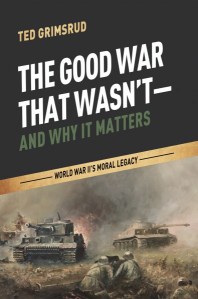
A new book on World War II’s moral legacy

December 3, 2014—Ted Grimsrud

Cascade Books has just published my book, The Good War That Wasn’t—And Why It Matters: World War II’s Moral Legacy. Here is the home page for the book on my website, with links to other sites where it can be previewed and purchased.9781625641021

This book is, in essence, a pacifist’s attempt to answer the question, “what about Hitler?” or “what about World War II?” using the moral reasoning of the just war tradition and common American values.

How the book is unique, as far as I know, is that it not only interrogates the War itself, it also traces the impact of the War on American national security policy in the generations since—as well as looking closely as the story of the war opponents and their legacy. Continue reading