Category Archives: peace theology

The Old Testament as a peace book

Ted Grimsrud

[This was the first of a two-part Carol Grizzard-Browning Lecture Series—University of Pikeville (Pikeville, KY)—11/11/13 (here’s part 2 on the New Testament)]

What I will do with this lecture on the Old Testament and with my second lecture on the New Testament is share about some things I have been passionately engaged with now for about 40 years.

A journey to pacifism

When I went to college in the mid-1970s, the Vietnam War was coming to an end. I registered for the draft, and was ready to fight if called. The draft ended, though, before I was called. That marked a turning point in my life, nonetheless.

I had just become a Christian. I was taught a Christian should be patriotic and be willing to fight for one’s country. However, I was also urged to read the Bible, especially to read the story of Jesus my savior in the gospels. The gospel story presented Jesus as a peacemaker. This challenged me as I struggled with the possibility of going to war. I also learned to know a number of veterans returning from Vietnam. They told horrific stories—and themselves quite often were traumatized. War didn’t seem so attractive.

About the time I finished college, I came to a clear conviction that I could not fight in war, that I was a pacifist. This conviction came shortly after I had deepened my commitment to live as a Christian—the two went together, as I resolved to be a serious Christian I committed myself to be a pacifist. What I meant by “pacifist” first was “the conviction that it is never morally acceptable to fight in or support war.” My current definition is more like this: “The conviction that no causes or values can override the commitment to treat each life as precious.” In either case, to be a Christian pacifist is to affirm these convictions due to one’s understanding of Jesus’s message.

My task then became—and remains—one of faith seeking understanding. What does it mean to be a Christian pacifist? How should I read the Bible in relation to these convictions? What about all the questions and problems—and the stubborn fact that just about all Christians for hundreds and hundreds of years have not accepted pacifism?

It helped that I had some experience being a minority. I was the only boy with four sisters. I was the only University of Oregon fan in a community filled with Oregon State fans. I was used to being a bit different, so being part of the tiny pacifist minority in a religion filled with warriors was not itself enough to make me think I was wrong…. Continue reading

Christian pacifism and the “Good War”

Ted Grimsrud—June 1 2015

[This essay was written for what appears now to be an aborted book that was to collect essays from various writers on Christian pacifism.]

Does Christian pacifism make the claim that everyone should be pacifist? Or is pacifism only a calling for those who affirm Jesus as Lord? This issue can—and should—be addressed on a theological and philosophical level. However, it may also be addressed on a more pragmatic level. Are there wars that should have been fought, that could be considered legitimately justifiable wars? If there are no ways that any actual war could be justifiable, is that a basis for claiming that everyone should be pacifist (defining “pacifism” here as the conviction that one should never take part in or support warfare)?

The one certain “just war”?

One way to begin to address the question about how widely we should advocate for pacifism is to look closely at the one war that most Americans, at least, including even many American pacifists, believe was a “just war”—World War II. Robert Brimlow, a Roman Catholic philosopher and committed pacifist, draws such a conclusion: “The war against Hitler, Nazism, and the atrocities they perpetuated certainly satisfies all the requirements for a just war: even if no other war was justifiable, even if every other dispute could have been settled by nonviolent means, that dispute could only have been solved through violence.”[1]

This statement is part of Brimlow’s argument in favor of pacifism—but it’s a pacifism based on a sense of the special calling of followers of Jesus. The kind of nonviolence Brimlow advocates is based on faithfulness, not on the expectation that it might practically be the best way to deal with conflict.

In the same book with Brimlow’s essay, Methodist theologian Stephen Long makes a similar argument. Long also suggests that World War II may be seen as a just war, where it was shown that “violence and war do sometimes work.”[2] Long argues for what he calls “christological pacifism,” an approach that “only makes sense because of the christological convictions we hold about what God has done in Christ. If Jesus is not the unique and definitive expression of God’s economy, of how God redeems the world and engages it politically through the cross, resurrection, and ascension—if he were not bodily raised from the dead—then pacifism makes no sense.”[3] Continue reading

A new book!

Ted Grimsrud—September 6, 2016

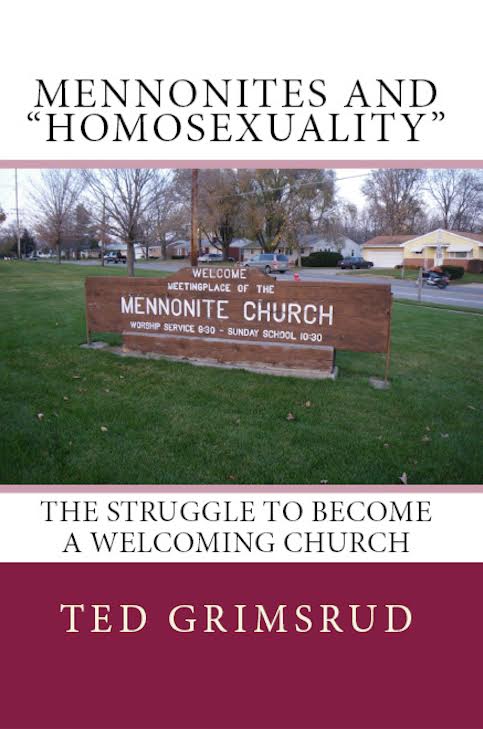
I am happy to announce the publication of a new collection of my writings, Mennonites and “Homosexuality”: The Struggle to Become a Welcoming Church. The essays, blog posts, and lectures in this collection were produced over the past fifteen years in the context of the conversations in Mennonite communities concerning inclusion of sexual minorities.

Some of the chapters focus on biblical interpretation, some on the history of Mennonite responses to these issues, and some on responding to many of the writings Christians have produced during these years.

The book both provides a historical perspective on these challenging years for Mennonites and a coherent biblical and theological argument in favor of inclusion.

Here is a link to the book’s website that includes information on purchasing the book. It is now available as a paperback online from Amazon ($20) and Barnes and Noble ($15.58) and as an e-book on Amazon Kindle ($8). It may also be purchased directly from the author ($10 in person and $15 postpaid through the mail).

Is Revelation’s God a God of peace?

A sermon preached at Community Mennonite Church Lancaster

May 8, 2016 by Ted Grimsrud

The book of Revelation is a mystery, right? Scary, intimidating, fantastic, wacky, off-putting. When Kathleen and I first moved to Harrisonburg 20 years ago, we attended Park View Mennonite Church. We learned there how back in the 1950s, the Mennonites in Harrisonburg had intense conflicts about the interpretation of Revelation. So, in good Mennonite fashion, they decided they needed to stop talking about it. So, those who grew up after that had no exposure to Revelation. However, maybe, also, Revelation is fascinating and even inspiring. I think it’s worth wrestling with, and it may even have special importance for we who live today in the center of the world’s one great superpower.

What are we looking for?

When we take up Revelation, though, just like any other religious text, so much depends on what we are looking for. Let me give some examples from who have written on Revelation. Are we looking for the date of the rapture and the identity of the Antichrist (like with the Left Behind books)? Or are we looking for the lunatic ravings of a hallucinating first-century fanatic (that’s what British novelist D. H. Lawrence thought)? Or are we looking for words of encouragement in face of a vicious authoritarian state (like South African theologian Allan Boesak 30-some years ago)? Or are we looking for a challenge to American imperialism (with the great American prophet of the 1960s and 70s William Stringfellow)?

And what kind of God do we expect to find “revealed” in this book? We all tend to try to find what will reinforce our already existing beliefs. We don’t always look very kindly toward images and ideas that threaten what we think we know. I’m reminded of one of my favorite quotes, from the social thinker John Kenneth Galbraith: “Sometimes we face a choice, do we change our minds or do we prove that we don’t need to. When faced with such a choice, most of us most of the time get busy with the proof.”… We tend not to want to change our minds. So if we expect a mean God in Revelation, that’s likely what we will find.

Still, it is a good idea to at least try to listen to different views. And certainly it’s a good idea to try at least to listen to the Book of Revelation with an open mind, to listen with the possibility that it might have something to say to us a bit different than what we expect—maybe it’s actually meaningful! Or meaningful in a different way that what we have assumed.

My sense with Revelation is that most people start with the assumption that Revelation’s God is violent and judgmental. Some might want that kind of God—some don’t. One of the pivotal moments in my own theological journey came nearly 40 years ago when a couple of friends had a formal debate in our church about pacifism. The non-pacifist drew heavily on the judgment in Revelation. He used it to support his belief that sometimes God is violent and thus may, at times, want us to be as well. That statement challenged me to study Revelation to see for myself. Continue reading

Revelation Notes (Chapter 19)

Ted Grimsrud

[See notes on Revelation 18]

Though both at the end of chapter sixteen and chapter eighteen, John writes of the completion of the destruction of Babylon, the story is not over, not even the destructive elements. However, it is crucial for the storyline that Babylon not longer exists as a lure to turn people from God. John turns toward another celebration scene at the beginning of chapter nineteen. Here, though there is a sense of something new—unlike earlier worship visions, this one is not so much celebrating the Lamb’s victory amidst the plagues. Now a crucial corner has been turned, Babylon is no more, and the New Jerusalem is much closer.

The final “battle” is just ahead, followed by the final judgment of humanity and the Dragon meeting his end. In all of this, John’s readers are challenged to remember the Lamb’s way as the way of God—and the path to victory for the entire world. The outcome is the healing and genuine justice of the New Jerusalem.

Revelation 19:1-10

The worship scene picks up on several images from earlier in the book. The “great multitude” points most directly back to chapter seven, though it also evokes the worship scenes from chapters five, twelve, fourteen, and fifteen. In chapter seven, in the midst of the seal series of plagues, John sees “a great multitude” beyond counting, “from every nation, from all tribes and peoples and languages” praising God and the Lamb to whom “salvation belongs” (7:9-10). Both “great multitudes” are dressed in white robes (7:9, 14; 19:8).

As with the earlier visions, here we have massive praise, “salvation and glory and power to our God” (19:1). The new dimension is that now we are told that God has “judged the great Harlot who corrupted the earth with her fornication.” God has brought justice due to the Harlot shedding “the blood of God’s servants” (19:2). As we know, and will be confirmed again in the second half of chapter nineteen, God’s method of gaining justice in relation to Babylon through persevering love even in the face of violent bloodletting by the structures of domination. And this justice will result in the destruction of the powers of evil and the healing of the kings of the earth and the nations. Continue reading

Revelation Notes (Chapter 17)

Ted Grimsrud—July 19, 2015

[See notes on Revelation 16]

We read at the end of chapter sixteen, “God remembered great Babylon and gave her the wine-cup of the fury of his wrath” (16:19). Now, in chapter seventeen and eighteen, the details of that “remembrance” will be presented. One of the bowl-plague angels comes to John to take him to see the “judgment of the great harlot” (17:1).

We should note that it is presumably the same angel who will later come again to John to take him to see “the bride, the wife of the Lamb,” that is, New Jerusalem (21:9). The same exact wording is used in both places, indicating that these two visions should be understood in relation to one another. These are the two destinations that John holds out for his readers—trust in the Dragon and end up in fallen Babylon or trust in God and end up in New Jerusalem.

Revelation 17:1-6

We have got here a central symbol that is referring to another symbol. The “great harlot” refers to “great Babylon.” Clearly John does not have in mind an actual prostitute. And by the time of this writing, the ancient city of Babylon no longer existed. Probably the main source for the metaphors is the Old Testament. Already in the Old Testament these two images were used to signify the social embodiments of idolatry, rebellion against God, violence, and injustice.

On the immediate level, John surely means to apply these symbols to Rome, the “city of seven hills” (17:9) that “rules over the kings of the earth” (17:18). Rome, who promises peace and insists that it operates with divine favor, stands as the most profound temptation for John’s readers. Those John most vociferously opposes apparently suggested that followers of Jesus many also function as comfortable actors in the Roman world—including taking part in the requisite public expressions of acquiescence to Roman civil religion. The worship moments scattered throughout Revelation are meant to counter that acquiescence.

We should read this account now as reflecting a broader critique. Just as Babylon, formerly a great empire but by John’s time a distant memory, worked metaphorically to provide insight into the character of the Roman Empire, so now Rome, also formerly a great empire but now a distant memory, works metaphorically to provide insight into the character of present-day empires (and all other empires throughout history)—most obviously for readers of this book, the American Empire. Continue reading

Revelation Notes (Chapter 16)

Ted Grimsrud

[See notes of Revelation 15]

Revelation sixteen describes all seven of the final set of plagues—the “bowl plagues” where seven angels pour out onto the earth “the wrath of God” (16:1). Unlike the partial destruction that the two early series of plagues (seals and trumpets) describe (in turn, one-quarter and one-third—perhaps the thunder plagues that were “sealed up” and not reported [10:4] would have told of one-half destruction), here the destruction is total (“every living thing in the sea died,” 16:3). With the seventh plague “a loud voice came out of the temple, from the throne, saying ‘It is done!’” (16:17). Now, John’s reporting of the “revelation of Jesus Christ” is not done. We still have six more chapters and several important visions to go. But this is the final plague and the expanding circle of destruction has reached its climax. The dynamics of wrath and destruction seem to have reached their culmination here. We will need to think carefully about these plague visions and also consider what is to come in Revelation—all in light of the core visions we have already heard, especially chapter five’s vision of the triumph of the Lamb—before we draw conclusions about what is being communicated in this chapter.

Revelation 16:1-11

The “loud voice from the temple” almost certainly is God’s voice telling the angels to “pour out on the earth” bowls of the “wrath of God” (16:1). We should read this description in light of what we have already discerned about God, the plagues, and wrath. The basic idea may be we are again going to have described for us the dynamics on earth during the “three and a half years” where the Dragon and his minions are wreaking havoc—but not in a way that will actually defeat God. “God’s wrath,” thus is not God direct anger being visited upon the earth in order to punish wrongdoing. Rather, it is what results when people turn against God and order their lives on the values of domination and exploitation—gaining their marching orders from the Beast and not from the Lamb. On a certain level, we may say that God allows the spiral of destruction loosed by the Dragon, but also that this spiral of destruction actually leads to the destruction of the Dragon himself along with the Beast and the False Prophet. Continue reading

Revelation Notes (Chapter 14)

Ted Grimsrud

[See notes on Revelation 13]

Chapter thirteen concludes with a call to wisdom. The picture of the Beast and the False Prophet exercising domination reflects the perspective many of John’s readers would have had. Some would have welcomed the Empire’s kind of “peace” and sought to accommodate with its ways to protect themselves from the kinds of consequences to resistance that are alluded to with the Beast “making war on the saints” (13:7). Others would have still believed in resisting the Beast but would have despaired of fighting “against it” (13:4).

So the call to wisdom is crucial (much more so than the exact meaning of the 666). The Beast might simply destroy the witness of the Lamb’s assembly—either by crushing the resisters or, more likely, by converting them to an accommodating approach to faith where the Beast and the Lamb seemingly coexist.

John wastes no time, though, in countering the temptation to accommodate or despair. Of course, the content in Revelation leading up to the vision in chapter thirteen also gave powerful reasons not to take that vision as definitive of the actual situation. Jesus already has been identified as the ruler of the kings of the earth, worthy to be worshiped by all creation and the one who brings healing to countless multitudes from all corners of the earth. Chapter fourteen, then, actually does not provide the antidote to the Beast’s claims so much as reiterate what has already been asserted—but with new depth.

Revelation 14:1-5

The impact of the contrast between the “I saw…” of 13:1 and the “then I saw…” of 13:11 with the “then I looked…” of 14:1 is lessened a bit by the chapter division. However, the three need to be read together. The vision of 14:1-5 is the conclusion to the Beast account. What is seen in chapter thirteen only has meaning in Revelation in light of the conclusion in 14:1-5. Continue reading

Revelation Notes (chapter 13)

Ted Grimsrud

[See notes on Revelation 12]

Chapter 12 ended with an ominous image, “the Dragon was angry with the woman, and went off to make war on the rest of her children, those who keep the commandments of God and hold the testimony of Jesus” (12:17). What follows will be an account of this “war,” though we should understand that what this verse refers to is the same phenomenon we have already seen in the plague visions.

And, crucially, we also already know the outcome of this war. Revelation does not allow for any doubts about the outcome of the Dragon’s war. Right away, back at 1:5, we read the affirmation that Jesus is the victorious “ruler of the kings of the earth.” Then, the center point of the book, chapter five, proclaims Jesus as worthy “to receive power and wealth and honor and glory and blessing” (5:12).

So, whatever the impression we might get from the picture of the Dragon’s “war,” especially in the vision of the mighty Beast we see in chapter thirteen, this is a war that is not really a war. The outcome is not in doubt—and, as we will see, the methods of combat between the Dragon’s side and those “who told the testimony of Jesus” are quite different, two diametrically opposed approaches to “conquering.”

Revelation 13:1-10—The Beast from the sea and the politics of domination

We briefly met the Beast back in chapter eleven where the “two witnesses” (essentially the same as those who hold the testimony of Jesus in 12:17) are warred upon, conquered and killed by the Beast “that comes up from the bottomless pit” (11:7). This “bottomless pit” is first mentioned at 9:1, where a “fallen star” goes from heaven to earth, is given a key to the shaft of the bottomless pit, and sets a plague of locusts who torture “those who do not have the seal of God on their foreheads … for five months” (9:4-5). Continue reading

Sin: What it is and what to do about it—Paul’s message in Romans 6

Ted Grimsrud

A sermon preached at Shalom Mennonite Congregation—Harrisonburg, VA, June 14, 2015, Romans 6:1-23

Sometimes little things are powerful—the most dangerous spiders are those little brown recluses. The hottest chili peppers are the tiny Carolina creepers. And the word “sin”—with only three letters—has all kinds of significance for religious people, and those who know religious people.

Problems with “sin”

One of the problems in North American Christianity is that the word sin is used mainly by people on one side of the theological spectrum. It feels like a harsh and finger pointing kind of word. So good peaceable progressives tend to avoid it. The result is a kind of self-fulfilling prophecy where everybody cedes the meaning of sin to those who do use it in hurtful ways.

We all do know that to call something a sin is to say it’s very bad. It’s like the famous story about President Calvin Coolidge back in the 1920s. He was notoriously a man of few words. One Sunday he went to church and later met with some reporters. “What was the sermon about,” he was asked. “It was about sin.” “What did the preacher say about sin?” “He said he was agin it.” … What more is there to say?

Well, a few decades later, the Louvin Brothers, one of the great country music brother singing acts , recorded a song called “Broadminded” that did say a little more: “That word broadminded is spelled s-i-n. I read in my Bible, they shall not enter in. Depart, I never knew you. That word broadminded is spelled s-i-n.” The song goes on to list the really bad sins—to “gamble now and then for pleasure,” to “drink a little whisky to please a friend,” and to go “dancing with friends.”

Of course we can think of even more hurtful ways the label sin is used. If it’s people others want to exclude or silence or marginalize, they can be accused of being sinful, of “living in sin.” One of the reasons this hurtful use of sin language is too bad is that many of us tend to react against using it at all then—and that makes for a challenge when we want to find language to use to talk about things that are genuinely wrong—like war and environmental exploitation and racism. We don’t find it meaningful to say those things are sinful—but we don’t have other words that work, either.

But there is another problem with the way “sin” is used among Christians. If it’s used as a word for the evils of “broadmindedness” or if it’s a word we refuse to use—in both cases we think of “sin” mainly as rule violations or moralistically objectionable behavior. To think of sin in these ways makes it harder to understand one of the Apostle Paul’s use of sin language—and we miss Paul’s helpful contributions to how we might approach life in healing and creative ways. Continue reading