Category Archives: Biblical theology

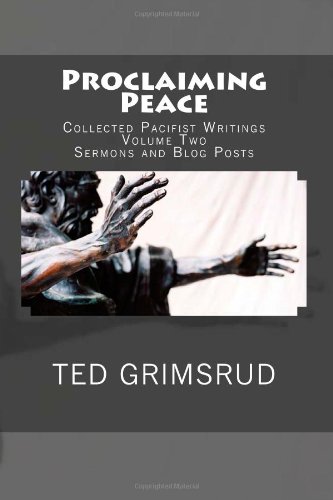
NEW BOOK: Proclaiming Peace by Ted Grimsrud

41BHQZyn1AL

A Mennonite pastor and blogger gathers fifty short writings that present a powerful message of world transformation and healing inspired by Jesus’ way of shalom.

TABLE OF CONTENTS

SECTION ONE: Sermons

A. Introduction to Pacifism

B. Old Testament

C. Gospels

D. New Testament Writings

SECTION TWO: Blog Posts

A. Pacifism

B. World War II

C. Theology

PUBLICATION DATA

Ted Grimsrud. Proclaiming Peace: Collected Pacifist Writings, Volume Two: Sermons and Blog Posts. Harrisonburg, Virginia: Peace Theology Books, 2013. ix + 226 pages. [See a preview of the book on the Amazon site.]

ENDORSING BLURB

“I read many peace-related blogs. I am here to say that if you only read on internet site related to Christian peacemaking, read Ted Grimsrud’s PeaceTheology.net. In his accompanying blog, ThinkingPacifism.net, he is ‘thinking aloud’ on peace-related subjects in perceptive ways. Ted is charting what I believe to be the most hopeful ‘post-John Howard Yoder’ path in Anabaptist pacifist thought.”—Michael Westmoreland-While, Pilgrim Pathways

PURCHASING INFORMATION

This book may be purchased from the following e-retailers:

Amazon ($13.50)

Barnes and Noble ($13.68)

Amazon Kindle ($5)

Powell’s Books ($15.50)

It may also be purchased directly from the author for $10 (only in person, no mail orders)

The New Testament as a peace book

Ted Grimsrud

[This is the second of two lectures in the Carol Grizzard-Browning Lecture Series at the University of Pikeville (Pikeville, Kentucky). It was presented November 12, 2013. The first lecture was “The Old Testament as a peace book” and may be found here.]

Let me start with a bold claim. The New Testament presents a political philosophy. This philosophy has at its core a commitment to pacifism (by pacifism I mean the conviction that no cause or value can override the commitment to treat each life as precious). This commitment is based on the belief that Jesus Christ as God Incarnate reveals the character of God and of God’s intention for human social life.

Jesus’s identity in the Gospel of Luke

In talking about the New Testament as a peace book, I will look first at how the gospels present Jesus. I will focus on the Gospel of Luke. At the very beginning, from Mary, upon her learning of the child she will bear, we hear that this child will address social reality. He will challenge the power elite of his world and lift up those at the bottom of the social ladder. This child, we are told, will bring hope to those who desire the “consolation of Israel.” Those who seek freedom from the cultural domination of one great empire after another that had been imposed upon Jesus’ people for six centuries will find comfort. From the beginning, this child is perceived in social and political terms.

Later, at the moment of Jesus’ baptism, God’s voice speaks words of affirmation, “Thou art my Son” (Luke 3:22). These words should be understood to name Jesus’s vocation more than simply emphasizing his divine identity. “Son of God” was a term for kings (Psalm 2:7). It states that this person is the leader of God’s kingdom on earth, he has the task of showing the way for God’s will for God’s people to be embodied.

Jesus’ baptism was a kind of commissioning service for this vocation. We see that in the events that following shortly afterward. Jesus retreats deeper into the wilderness and there encounters Satan, the tempter. Satan presented Jesus with temptations that all had at their core seductive appeals to his sense of messianic or kingly calling. He could rule the nations, he could gain a following as a distributor of bread to the hungry masses, he could leap from the top of the Temple and gain the support of the religious powers-that-be through his miraculous survival that would confirm his messianic status. That is, Jesus faced temptations concerning how he would be king. He did not deny that he was called to be “Son of God”—that is, king or messiah. But he did reject temptations to be king in ways he knew would be ungodly. Continue reading

The Old Testament as a peace book

Ted Grimsrud

[This is the first of two lectures in the Carol Grizzard-Browning Lecture Series at the University of Pikeville (Pikeville, Kentucky). It was presented November 11, 2013. The second lecture was “The New Testament as a peace book” and is posted here.]

What I will do in this lecture on the Old Testament and my second lecture on the New Testament is share about some things I have been passionately engaged with now for about 40 years.

A journey to pacifism

When I went to college in the mid-1970s, the Vietnam War was coming to an end. I registered for the draft, and was ready to fight if called. The draft ended, though, before I was called. That marked a turning point in my life, nonetheless.

I had just become a Christian. I was taught a Christian should be patriotic and be willing to fight for one’s country. However, I was also urged to read the Bible, especially to read the story of Jesus my savior in the gospels. The gospel story presented Jesus as a peacemaker. This challenged me as I struggled with the possibility of going to war. I also learned to know a number of veterans returning from Vietnam. They told horrific stories—and themselves quite often were traumatized. War didn’t seem so attractive.

About the time I finished college, I came to a clear conviction that I could not fight in war, that I was a pacifist. This conviction came shortly after I had deepened my commitment to live as a Christian—the two went together, as I resolved to be a serious Christian I committed myself to be a pacifist. What I meant by “pacifist” first was “the conviction that it is never morally acceptable to fight in or support war.” My current definition is more like this: “The conviction that no causes or values can override the commitment to treat each life as precious.” In either case, to be a Christian pacifist is to affirm these convictions due to one’s understanding of Jesus’s message.

My task then became—and remains—one of faith seeking understanding. What does it mean to be a Christian pacifist? How should I read the Bible in relation to these convictions? What about all the questions and problems—and the stubborn fact that just about all Christians for hundreds and hundreds of years have not accepted pacifism?

It helped that I had some experience being a minority. I was the only boy with four sisters. I was the only University of Oregon fan in a community filled with Oregon State fans. I was used to being a bit different, so being part of the tiny pacifist minority in a religion filled with warriors was not itself enough to make me think I was wrong….

Not long after my moment of clarity, I discovered a Christian tradition with a long history of pacifist belief and practice—and in time my wife Kathleen Temple and I joined with these Christians and became Mennonites. It has been crucial to not feel totally alone—to have a little bit of critical mass—in these strange beliefs. Continue reading

Why We (Should) Read Revelation

[This is the eighteenth (and last!) in a series of sermons on the Book of Revelation.]

Ted Grimsrud

Shalom Mennonite Congregation—November 17, 2013—Revelation in three minutes

It was, if I remember correctly, September 1982. I was in my late 20s. Kathleen and I were living in Eugene, Oregon. We had recently made the decision to join Eugene Mennonite Church—a decision we made after a wonderful year attending Associated Mennonite Biblical Seminaries. We had a sense of clarity that we were at home with Mennonites and in that particular, quirky but quite welcoming little congregation.

Full circle with Revelation

The Eugene church’s pastor took a sabbatical attending AMBS and I was asked to fill in as interim while he was gone. One of my main responsibilities was to preach regularly. All I had to do was figure out what to preach about. For some reason, I decided to preach on the book of Revelation.

I can’t remember now why in the world I chose to do that. I am sure the folks in Eugene wondered why in the world, as well. But, Mennonites are pretty polite. Like a friend of mine once said, with Mennonites it’s hard to tell the difference between praise and condemnation. People said nice, polite things—but I have to imagine they were really wondering what this kid preacher was going to try to pull on them.

I feel like I have come full circle now, as I complete this new series of sermons on Revelation. There is definitely some overlap between what I did those many years ago and what I have had to say this time through. But there is always new light to be shed on a fascinating and complicated text such as Revelation—and certainly the world and Ted Grimsrud have changed quite a bit in 30 years. Continue reading

What is Paradise For?

[This is the seventeenth in a series of sermons in interpreting America in the 21st century in light of the Book of Revelation. The series will continue, monthly through November 2013.]

Ted Grimsrud

Shalom Mennonite Congregation—October 13, 2013—Revelation 21:1–22:5

Kathleen and I love to read to each other. We sometimes struggle a bit in deciding what to read, though. She wants to read serious fiction and nonfiction. Stuff that is actually literature. That would make us think. That would give us genuine insight into the human condition. You know, Moby Dick. War and Peace. The Brothers Karamazov. The Autobiography of Malcolm X.

The attraction of happy endings

For me, on the other hand, it’s different. I mainly just want something with a happy ending. Not that much genuine literature has a happy ending. So, we read mostly stuff that’s not genuine literature. Books by someone like Carl Hiassen, where you know who the bad guy is from the start by the kind of music he listens to….

It is probably true that books with happy endings have sold a lot more copies than books with tragic endings. And we tend to read the Bible this way. Even though a lot of people don’t like the book of Revelation all that well, it does have a pretty happy ending, depending on how you interpret it.

I’m finally getting to the end of the book of Revelation with my sermon today. Maybe simply to be done with Revelation will itself be a happy ending—though I do plan one more sermon to kind of summarize things next month.

Revelation does end happily, with a vision of paradise. The book contains several allusions going clear back to Genesis, and I think we are meant to read Revelation as in some sense the conclusion to the entire Bible. Let me read a condensed version of chapter 21 and the first part of chapter 22.  Continue reading

The Judgment That’s Not a Judgment

[This is the sixteenth in a series of sermons in interpreting America in the 21st century in light of the Book of Revelation. The series will continue, monthly through November 2013.]

Ted Grimsrud

Shalom Mennonite Congregation—September 15, 2013—Revelation 20:1-15

I have an idea that as much as any part of the Bible, the book of Revelation works kinds of like a Rorschach test, you know where you look at an inkblot and tell the therapist what you see—with the idea that what you see reveals things about your psychological makeup.

So, we look at this messy blot of images in the last book of the Bible and what we see there reveals a lot about us. Certainly one of the things many see when they look at Revelation is judgment. But what kind of judgment? Maybe what we see when we see scenes of judgment is itself kind of a Rorschach test. What we make of judgment reveals a lot about our psychological makeup—or at least our theological makeup.

A debate about judgment

I have a memory from back in the late 1990s. I went with a number of people from EMU, faculty and students, to hear a prominent theologian, Miroslav Volf, speak at the Eastern Mennonite Mission Board headquarters in Mt. Joy, Pennsylvania.

Volf, who had just begun teaching at Yale University, wrote a well-received book called Exclusion and Embrace. It drew in poignant ways on his experience as a Croatian with the terrible violence in the Balkans conflicts he had lived in the midst of. He powerfully emphasized the need for forgiveness, compassion, and reconciliation in face of brokenness.

However, there was a key element of Volf’s argument, about judgment, that some of us felt uneasy with. He suggested that a major reason why Christians might advocate and practice this radical “embrace,” even of enemies, is because of our trust that in the end God will judge evildoers. This judgment will be punitive. We don’t have to do violence against offenders because we count on God’s violence in the end.

I can picture the room where we met. The audience was in a u-shaped set of chairs with the speaker at the open end of the U. I was directly to one of side of him and one of my like-minded students was clear on the other side. During the discussion we started firing questions from both sides, and Professor Volf was kind of whipping his head first clear in one direction and then, right away, clear to the other direction. Back and forth. It was a friendly if intense debate, and we didn’t resolve it. Continue reading

Revelation Notes (chapter 20)

Ted Grimsrud

[See notes on Revelation 19]

Revelation 20 comes in the middle of the final set of visions that complete the book of Revelation. The first part of chapter 19 shows the great celebration of the Lamb’s marriage following the fall of Babylon the Great in chapter 18. Then comes the battle that’s not really a battle where the rider on the white horse (Jesus, crucified and resurrected) captures two of his main enemies, the Beast and the False Prophet, and dispatches them (without an actual battle) to the lake of fire.

The book concludes in chapters 21 and 22 with a vision of the New Jerusalem, the city of genuine peace and healing that has been in the background from the beginning of Revelation. Tears are wiped away never to return, and ceaseless celebration and praise of the Lamb and the One on the throne ensues.

In between, in chapter 20, come a series of difficult to understand visions that complete the judgment and destruction of the powers of evil (here the Dragon, the power behind Babylon, the Beast, and the False Prophet) and that portray the judgment of all of humanity and the final destruction of Death and Hades.

I will suggest that these visions (along with the rest of Revelation, actually) should not be read strictly in terms of chronology. One of the interpretive approaches that especially makes the visions in chapter 20 confusing is to assume that this chapter presents events that will happen in the future after everything else that we have seen—rather than seeing this chapter as a kind of recapitulation of some of the main themes from earlier in the book. That is, Revelation 20 is also best understood as a picture of present reality. And it presents a theology of judgment that is actually quite different that what is usually assumed to be characteristic of Revelation.

Continue reading

Reflections on Old Testament worship and politics

From time to time, I have the privilege of writing short meditations on the biblical texts being studied in the quarterly Sunday School lessons that are published in the Mennonite World Review. This summer, the texts focused on the portrayal of worship in a small slice of the Old Testament. My six articles were published in MWR between May 27 and August 5. The first two articles dealt with texts from Isaiah, the middle two with texts from Ezra, and the final two with texts from Nehemiah.

I found it particularly interesting to reflect on the texts from Ezra and Nehemiah. They described the situation in ancient Israel following the return from exile after the Babylonians dealt the kingdom of Judah a devastating defeat. One key theme for me is the contrast between this time of constructing the second temple in the context of being part of a much larger empire (the Persians) that did not allow the Israelites to have political self-determination and the constructing of the first temple as the Israelite nation was settling in for a long but disastrous time of running their own kingdom.

Here is a link to the articles.

The War That’s Not a War

[This is the fifteenth in a series of sermons in interpreting America in the 21st century in light of the Book of Revelation. The series will continue, monthly for about two years.]

Ted Grimsrud

Shalom Mennonite Congregation—May 12, 2013—Revelation 19:1-21

One of the great things for me in looking closely at the book of Revelation again is that I keep noticing new things. I have talked quite a bit, and will some more today, about how I see “blood” everywhere in Revelation. Now, this is not unusual, a lot of people see red when they look at Revelation. However, I have noticed that the “blood” in Revelation is always the blood of Jesus or his followers; never do we hear of the blood of Jesus’s enemies being shed. This one-sided use of blood can’t be an accident.

I believe when we “follow the blood” in Revelation we see that one of the main messages of the book is a call to self-giving love. Jesus gave his life over to love, so should we. Revelation presents Jesus’ way of nonviolent resistance to the domination system as the model for his people—and as the method that overcomes that death-dealing system. Jesus’ “blood,” and that of his followers, stand for lives of compassion in resistance to domination.

The Powers keep coming back

Today I want to talk about something else I have noticed. Over and over again we are told that the beast, the dragon, the city Babylon, these powers that symbolize the domination system—over and over we are told that they are defeated, that they go down, that “it is all over.” Yet the powers keep coming back, they keep showing up.

Some of you may remember the old folk song, “The Cat Came Back.” It has also been turned into a children’s book—I remember reading it over and over to our son Johan when he was little. Mr. Johnson wants to get rid of this pesky old cat—“he gave it to a little man who was going far away, but the cat came back the very next day.” And it goes on, a little boy takes the cat on a boat trip. The boat capsizes; lives were lost. But still the cat came back. Even after the hydrogen bomb falls, the cat comes back. “They thought he was gone, but the cat came back, he just wouldn’t stay away.”

This is kind of like the dragon and his minions in Revelation. They go down in chapters 11 and 12, “it is over.” They go down in chapter 17. And then again in chapter 18. And at the beginning of chapter 19, the great harlot has been judged and smoke goes up from her forever and ever. And yet, in the second half of the chapter the powers of evil are back, gathered for the great battle of Armageddon. Continue reading