Author Archives: Ted Grimsrud

About Ted Grimsrud

I live in Virginia

Mennonite pacifism within the Christian tradition

Ted Grimsrud—VMRC Voices of Peace Symposium—1/30/26

(1) The meaning of pacifism and its biblical origins

I first met Mennonites about 50 years ago due to what they called “the peace position.” By that they meant a commitment to love, a commitment to care for all others, a belief in the preciousness of life—under all conditions. This commitment meant, among other things, an opposition to war in all its forms. Kathleen and I were looking for Christians like that.

I like “pacifism” as shorthand for all these commitments. “Pacifism” is to me an approach to life and to faith with love always at the center. I soon learned as I started to hang around with Mennonites that the term “pacifism” was complicated. Other terms (all also complicated) I first learned included “nonresistance,” “defenselessness,” and “the love ethic.” Terms I learned later include “nonviolence” and “peacebuilding.” The simple point I would like to make here is that I don’t think the specific term we use is what matters. What matters is the content: the commitment to love under all conditions. That is what I will talk about here when I say “pacifism.”

When I talk about pacifism, I start with the Bible. Perhaps surprisingly, though, I start with the Old Testament. At the beginning of the book of Exodus, the children of Israel are a chaotic mess. They have little memory of their identity, enslaved in Egypt, ceaselessly ground down in a violent world of top-down power. All that seems to matter is the wealth and power of the people at the top. The enslaved Hebrews, in their trauma and despair, cry out to the heavens. And they are heard. The God of Abraham, as if awoken from slumber, hears the people’s cries. God remembers the promises made of old that these would be a people who would bless all the families of the earth. God finally intervenes and sends the people a prophet, Moses, who brings together the Hebrew community. God gets them out of Egypt and gives them the law (“Torah”), a blueprint for healthy, just, humane living. We could call this a counter-empire vision.
Continue reading

Remembering the thought of Walter Wink

[The New Testament scholar and peace activist Walter Wink died in 2012. While his books and his thought continue to receive attention, they are not given enough attention in my opinion. As a small effort to try to remedy that problem, I am posting a short essay I wrote about 20 years ago introducing some of Wink’s main ideas. This essay was part of the introduction I wrote to the book of essays on Wink’s thought I coedited with my friend Ray Gingerich, Transforming the Powers.]

Engaging Walter Wink: An Introduction—by Ted Grimsrud—[From Ray Gingerich and Ted Grimsrud, eds. Transforming the Powers: Peace Justice, and the Domination System (Fortress Press, 2006), 1-6.]

Walter Wink is that rare, and much appreciated, cross-disciplinary scholar and committed activist who informs and inspires. Trained as a New Testament specialist, Wink’s first publications in the late 1960s made still-cited contributions to the study of John the Baptist.[1] John the Baptist in the Gospel Tradition remains in print. He began reaching a wider audience with his provocative The Bible in Human Transformation[2] which forecast his broadening his concerns to psychological and ethical ramifications of how we read the Bible. Transforming Bible Study[3] emerged from Wink’s work as Professor of Biblical Interpretation at Auburn Theological Seminary in New York, work paying special attention to the study of the Bible among lay people.

The Powers trilogy

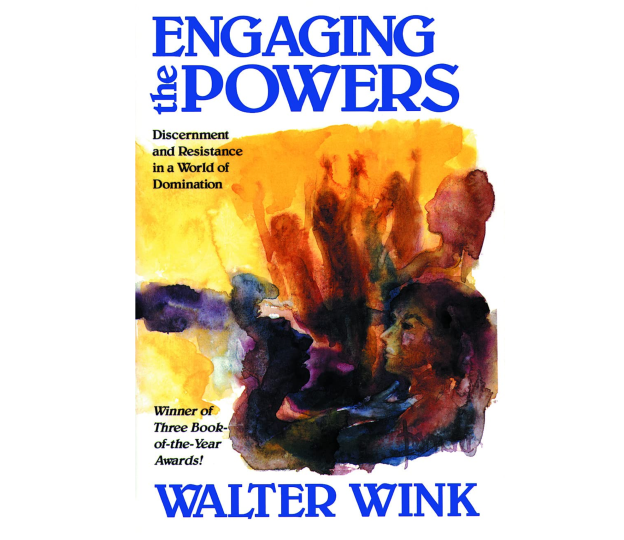
Fortress Press published the first volume of Wink’s “Powers trilogy,” Naming the Powers: The Language of Power in the New Testament in 1984. As Wink recounts in that book’s preface, it originated as a book review, critiquing another book on the principalities and powers in the New Testament that Wink disagreed with. Wink had been working on the theme of the powers for a number of years, originally stimulated by the pioneering work of the notorious Episcopalian lawyer and lay theologian William Stringfellow. What eventually emerged were two additional full-scale books, Unmasking the Powers: The Invisible Forces That Determine Human Existence (1986) and the magisterial Engaging the Powers: Discernment and Resistance in a World of Domination (1992), and several shorter works fleshing out the trilogy’s core insights.

Wink argues that the “principalities and powers,” in the New Testament (and he uses this term as shorthand for the various other terms that also expresses the idea) refer to the realities of all human social dynamics – our institutions, belief systems, traditions, and the like. All of these dynamics, what he calls “manifestations of power” have an inner and an outer aspect. “Every Power tends to have a visible pole, an outer form – be it a church, a nation, and economy – and an invisible pole, an inner spirit or driving force that animates, legitimates, and regulates its physical manifestation in the world. Neither pole is the cause of the other. Both come into existence together and cease to exist together.”[4]

Continue reading

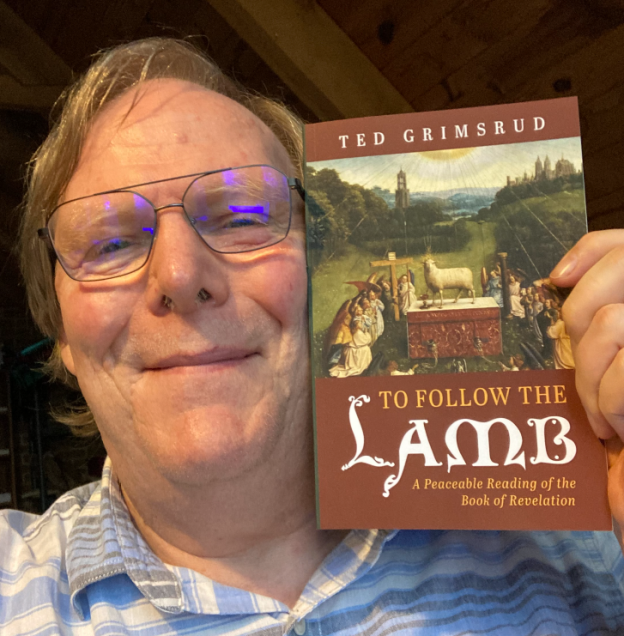
NEW BOOK—To Follow the Lamb: A Peaceable Reading of the Book of Revelation

I am happy to announce the publication of my most recent book: To Follow the Lamb: A Peaceable Reading of the Book of Revelation (Cascade Books, 2022), ix + 278pp.

To Follow the Lamb is a commentary of the entire book of Revelation that places a special emphasis on the peace message of Revelation. Revelation is not a book that portrays a violent, vengeful God but rather than shows God to be most profoundly revealed in the gracious Lamb. The key to reading Revelation is to take seriously the opening words of the Book that tell us it is a”revelation of Jesus Christ.”

Revelation is an exhortation to discipleship—follow the Lamb wherever he goes! It offers a sharp critique of the world’s empires and a sharp critique of how people of faith all too easily find ways to be comfortable within the empires. Revelation portrays God as merciful and peaceable—but engaged in a battle against the spiritual powers of evil that energize the nations’ domination systems.This battle, though, is fought with the weapons of love, not worldly violent weapons.

Available online from:

Amazon (the Kindle version is only $9.99)

Wipf and Stock Publishers

Both sites have previews that show the first part of the book.

Also available at: Bookshop.org

Endorsements:

“Ted Grimsrud is a worthy and capable guide through the often misread and confusing images laid out by John of Patmos to the churches of Roman Asia. Anyone who has ever wondered how to make sense of this powerful narrative will find a great companion in To Follow the Lamb. Go form a study group and dig in!”—WES HOWARD-BROOK, Seattle University, author of Unveiling Empire: Reading Revelation Then and Now

“In this important book, Ted Grimsrud clears away decades of misunderstanding and misuse to reveal the beauty and power of the Apocalypse. Writing with deep insight and lucid prose, Grimsrud forcefully challenges violent interpretations of Revelation and fixes our gaze on the nonviolent Jesus. A treasure trove for peacemakers and justice seekers, To Follow the Lamb is accessible, relevant, and sorely needed. Guaranteed to deepen your appreciation of Revelation—I highly recommend it!”—ERIC SEIBERT, Messiah University, author of Disarming the Church: Why Christians Must Forsake Violence to Follow Jesus and Change the World

“In the midst of the sometimes violent rhetoric of Revelation, Grimsrud makes abundantly clear that Revelation features the nonviolent victory by the slain and resurrected Lamb, who reveals a nonviolent God, over the powers of evil, represented by the Roman empire. One of the most valuable contributions of this comprehensive theological analysis of Revelation is how it applies the book’s nonviolent resistance to empire to our call to challenge the American empire.”—J. DENNY WEAVER, Bluffton University, author of God Without Violence

More posts on Peaceable Revelation

A friendly approach to the Bible

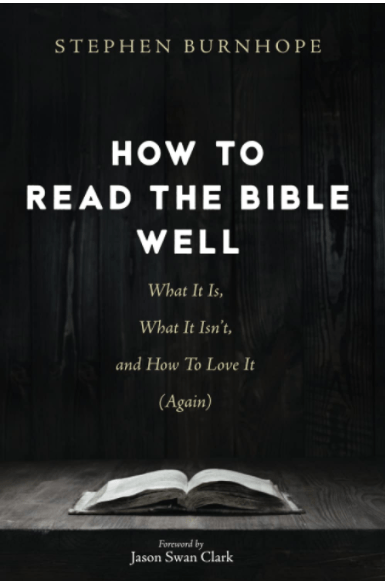
Stephen Burnhope. How to Read the Bible Well: What It Is, What It Isn’t, and How to Love It (Again). Cascade Books, 2021.

Stephen Burnhope is a British Evangelical pastor-scholar. How to Read the Bible Well reflects the strengths of the combination of those two vocations. The writing is clear and accessible. The focus is on practical theology in the sense of how the Bible may be read in ways that encourage faithful living. Burnhope is not interested in abstract, authoritarian theology. At the same time, he is well-read and draws effectively on current theological scholarship.

This book serves as a good resource for people who want to know not only how we best read the Bible, but why we do so. For someone working in an Evangelical context, Burnhope displays an admirable openness and honesty about the alleged problems of the Bible—its apparent internal contradictions, its humanness, its proclivity to give us positive views of violence, the tensions between the Old and New Testaments, how Jesus can be God and human at the same time, and the problem of evil among others.

Being an Evangelical, Burnhope’s thoughtful responses to these issues tends toward affirming the Bible’s divine inspiration and its authority for Christians. He’s clearly right of center on most theological issues. Even for non-Evangelical readers, though, this conservatism should be seen as an asset more than a liability. We are not given simplistic, authoritarian answers here, but carefully reasoned affirmations of the positive role the Bible may play for seekers. We may consider some of Burnhope’s positions to be more traditional than we would prefer, but we will still learn good things by sharing in his wrestling with questions commonly asked about the Bible.

Continue reading

Reading the Bible as if Jesus matters

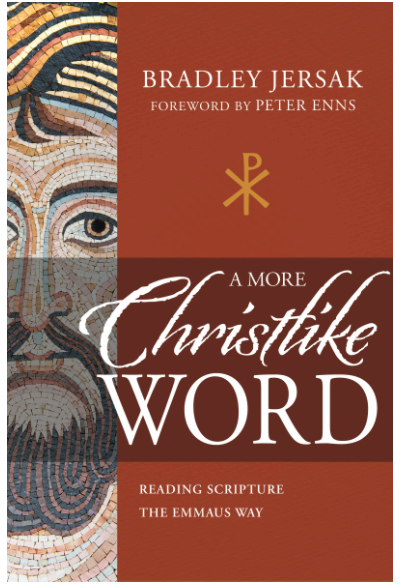
A response to: Bradley Jersak. A More Christlike Word: Reading Scripture the Emmaus Way. Whitaker House, 2021. 287pp.

This is a most helpful, even liberating, guide to reading the Bible with Jesus as the center. Bradley Jersak, a theologian and pastor who has traveled a fascinating path from Pentecostal fundamentalist to Eastern Orthodox with a stint among Mennonites, draws on his own evolving experiences with the Bible. Jersak presents us with an approach that walks the line between the authoritarian literalists on one side and the cultured despisers on the other side, and he provides an empowering and enlivening understanding of the Bible as witness to the healing path of Jesus.

The entire Bible witnesses to Jesus

Jersak calls his approach to the Bible “the Emmaus Way,” referring to the story in Luke 24 following Jesus’s resurrection. The risen Jesus encounters two his disciples walking on the road from Jerusalem to the nearby town of Emmaus. They don’t recognize him, taking him as a stranger to the area. They share their grief at Jesus’s death until he finally reveals himself and tells them not to grieve, that what happened was totally in line with message of the Bible. That is, the Bible—all of the Bible—points to Jesus as its center.

So, Jersak presents an approach where we take Jesus at his word and read the entirety of the Bible in light of Jesus’s life, teaching, death, and resurrection. When we do so, we will find the Bible come alive as a life-shaping guide to wholeness, generosity, mercy, and creativity. In harmony with Jersak’s message that the Bible is about joyful living, the writing style of A More Christlike Word is engaging, humorous, accessible, and encouraging. We learn a lot about Jersak’s own checkered journey of moving from a narrow, fearful reading strategy to his present open-hearted, welcoming, and gracious approach.

While the book has a popular, easily understood tone, it is also grounded in serious scholarship and perceptive theological and historical analyses. We learn a lot about the Christian tradition, including strengths and weaknesses of various prominent reading strategies over the centuries. We also learn a lot about the content of the Bible itself. Jersak’s sense of how it all fits together allows for differences within the canon in the context of an overall harmony. And, crucially, this overall harmony gives a positive, generous, life-giving message of God’s mercy embodied in Jesus’s life, death, and resurrection.

Continue reading

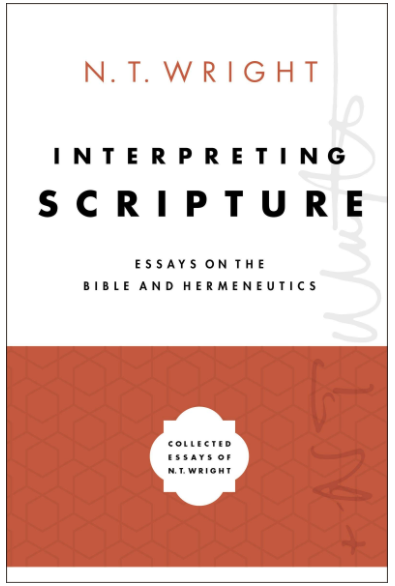
A review of N.T. Wright, Interpreting Scripture.

Ted Grimsrud—November 1, 2021

N.T. Wright. Interpreting Scripture: Essays on the Bible and Hermeneutics. Zondervan Academic, 2020. xii + 387pp.

This interesting collection of essays by the prominent New Testament professor N. T. Wright gives a chronological record of his interaction with biblical texts dating from 1997 to 2020. Most of the twenty-two essays have been published in various obscure journals and essay collections. They are all vintage Wright, mixing careful reading of texts with theological analysis. The essays are scholarly but written with Wright’s characteristic clarity and accessibility.

The title of the book is a bit misleading, though. Particularly, the term “hermeneutics” in the subtitle promises a theme that the book does not actually touch on. It would be quite useful to have some essays by Wright reflecting on the philosophy of biblical interpretation. His thoughts in that area surely are worth attending to. However, these are mainly essays that show how he interprets the specific biblical texts and addresses specific biblical themes, not essays that step back and examine the act of interpretation itself.

This is one of three volumes published simultaneously by Zondervan Academic, the other two being collections of essays focused on Jesus and on Paul respectively. This third volume could be understood as essays on what was left over. Even so, a few essays on Paul and on Jesus find their way into Interpreting Scripture, suggesting that the selection criteria were not scrupulously followed.

Continue reading

Challenging the Just War Tradition to Take Its Stated Values Seriously

Ted Grimsrud—October 5, 2011

[This paper was presented at a conference at James Madison University, Harrisonburg, VA, commemorating the ten-year anniversary of the 9/11/2001 attacks. The focus of the conference was on the on-going relevance of the just war theory.]

Often discussion about the morality of warfare sets in opposition just war philosophy with pacifism. My intent in this paper is to challenge just war adherents to work within their tradition to overcome the scourge of war. I believe that the just war tradition, if vitalized, could become a powerful resource for overcoming the scourge of war. Though I am a pacifist myself, I believe that it is likely only through a vitalized just war approach that the power of militarism in United States society can be reduced.

“Blank check” or pacifism

In practice, in the West throughout the past couple of thousand years two views concerning participation in warfare have been prominent—pacifism (characteristic of a tiny minority) and what I will call the “blank check.” The “blank check” says it is the citizen’s duty to do what the state asks. If the state says go to war, the citizen’s job is to obey, essentially without question. The just war philosophy has existed in the gray area between these two other views. Just war has mainly been about the ivory tower-type discussions of moral philosophers, usually about particular wars after the fact.

Augustine himself, considered the father of the just war doctrine, actually also taught a version of the blank check. Only the nation’s leaders had the role of determining a particular war’s justness; for the citizen, the task was simply to obey and assume that the leaders will suffer the consequences if they are fighting unjust wars.

Much more recently, conscription and the options that have been allowed for soldiers have reflected this same dynamic—blank check or pacifism. In the United States, people who can demonstrate that they are indeed pacifists (opposed to all war in principle) are allowed the legal recourse of conscientious objection. Everyone else is expected to enter the military if drafted and then obey their leaders, leaving to the leaders’ discernment about the justness of particular wars. The United States has never allowed those who adhere to just war principles to say, “No, I will not take part in this particular war because it is unjust.”

Continue reading

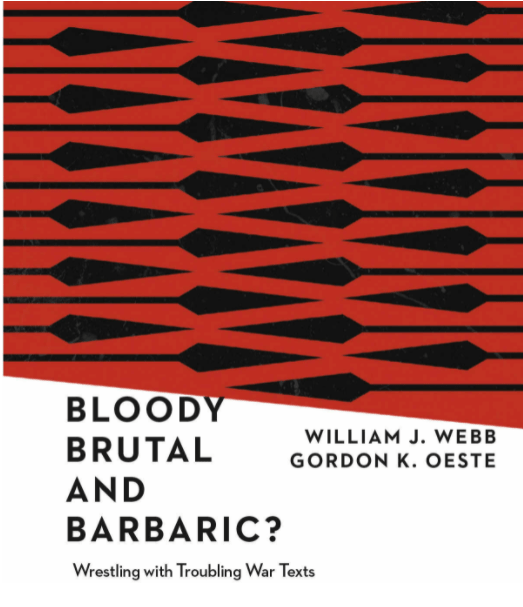
Another attempt to explain the violence in the Old Testament: A review of Bloody, Brutal, and Barbaric? by Webb and Oeste

Ted Grimsrud—July 26, 2021

In Bloody, Brutal, and Barbaric?: Wrestling with Troubling War Texts, William Webb and Gordon Oeste have given us a clearly written, comprehensive, and helpful treatment of the perennial challenge Christians face in seeking to understand the writings on divinely approved violence in the Old Testament. While overtly addressing a fairly narrow evangelical audience, the authors are sophisticated and insightful enough that anyone interested in this issue will find their book to be of value.

Webb and Oeste focus on two deeply troubling themes in the Old Testament, the stories of God-approved genocide along with what they call “war rape.” Theauthors argue that the “traditional view” of Old Testament violence is not adequate. This view holds that factual accounts of profoundly violent genocidal war in our present day are “roughly equivalent to what was happening in the biblical text” (34). And the presence of such accounts that (accurately) attribute such violence to God and God’s people should not trouble people of faith today. The traditional view sees: (1) God to be the source of the holy war commands, (2) biblical holy war to have “lofty and good purposes,” (3) the enemies of Israel to be evil and deserving of such violence, and (4) the holy wars to prefigure the final judgment at the end of time (34-35).

Webb and Oeste are actually fairly sympathetic with the traditional view. They dismiss without discussion what they call the “antitraditional view” (20). They write: “We do not develop the differences between our view and that antitraditional view. This omission reflects our intention that this book primarily addresses readers who either hold or have been raised within the traditional view” (20-21). This move significantly limits their potential audience—and seems unfortunate because many of those who have come to question their traditional views have found writers such as Eric Seibert and C.S. Cowles (the two examples of the antitraditional view cited by Webb and Oeste) to be helpful because, in spite of the impression given by Webb and Oeste, they share many theological convictions. Engagement with their views would have made Bloody, Brutal, and Barbaric? stronger.

Continue reading

Review of NotMyJesus

Bob Fabey. NotMyJesus: Embracing Our Sacred Role in a Changing World. Author Academy Elite, 2018

Ted Grimsrud—July 31, 2020

Of books about Jesus, there is no end. Personally, though, I’m always happy to encounter new ones. We continue to need fresh ways to understand the story of Jesus and its application for our day. We know, of course, though, that many of these books are not nearly as helpful as they could be.

Bob Fabey, a pastor in Phoenix, Arizona, has given us a lively, accessible, and concise little book that provides some good encouragement and guidance for embracing Jesus’s way of acceptance and compassion toward all people. It’s a quick read, and I have a hard time imagining that any open-hearted reader would not find the book uplifting—at least a little bit.

The book’s title and front cover convey a sense of edginess that is not actually matched by the content of the book. While the writing style is lively, the main message of the book seems to be an exhortation to be kind. This is valuable, certainly. Lingering in the background is an implicit repudiation of the politicized Christian Right.

Fabey does not give us much background on his own ecclesial journey. From the acknowledgments at the end of the book, it appears that he grew up in the Christian Missionary Alliance tradition. At some point he joined with the Anglican movement that has provided a theologically conservative alternative to the Episcopalian church. Continue reading

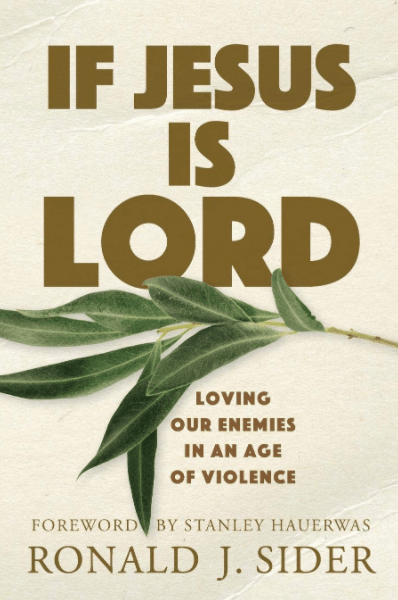
Christian pacifism as fully compatible with evangelical theology: Reviewing Ron Sider’s recent books on pacifism

Ronald J. Sider. If Jesus is Lord: Loving Enemies in an Age of Violence. Baker Academic, 2019. Xvi + 240 pages and Speak Your Peace: What the Bible Says About Loving Our Enemies. Herald Press, 2020. 199 pages.

Ted Grimsrud—July 11, 2020

Ron Sider, a longtime theology professor at Palmer Theological Seminary at Eastern University, has added to a long list of writings on social justice from an evangelical Christian perspective a kind of capstone on Christian pacifism. If Jesus is Lord is a solid, comprehensive account of biblically based Christian pacifism. Speak Your Peace is a somewhat more popularly written version of the same book. In this review, I will focus on the first of these two books.

What gives Sider’s books an authoritative heft is his long, sustained commitment to articulating and living out a Jesus-centered commitment to nonviolent engagement. Dating back to his influential bestseller Rich Christians in an Age of Hunger (first published in 1977 and revised numerous times, most recently in 2015), Sider has vigorously challenged his fellow evangelical Christians to take the wholistic gospel of peace seriously both with his writing and his organizing work with Evangelicals for Social Action. His first book on pacifism, Christ and Violence, was published way back in 1979 and has been followed by numerous others in the years since.

A Jesus-centered argument for pacifism

As would be expected (and this is a strength of the book), Sider moves immediately to the life and teaching of Jesus. The first four of the 14 chapters focus on Jesus’s practices and teachings that establish that the Bible’s core message is a message that calls upon believers to follow Jesus’s path of mercy, forgiveness, and nonviolent resistance to evil. Sider asserts that orthodox theology (which he defines especially in terms of an affirmation of Jesus’s divinity and identity as the second person of the trinity) actually strengthens the call to Christian pacifism. As the title of the book insists, “if Jesus is Lord” then his message of nonviolent engagement is a mandate for all who trust in him as their savior.

After developing the christological core of his pacifist convictions, Sider addresses a wide range of issues that often come up in discussions about pacifism. He shows how the rest of the New Testament emphasizes peace and in general reiterates Jesus’s message, while also refuting the claims that the rest of New Testament points away from pacifism. Continue reading